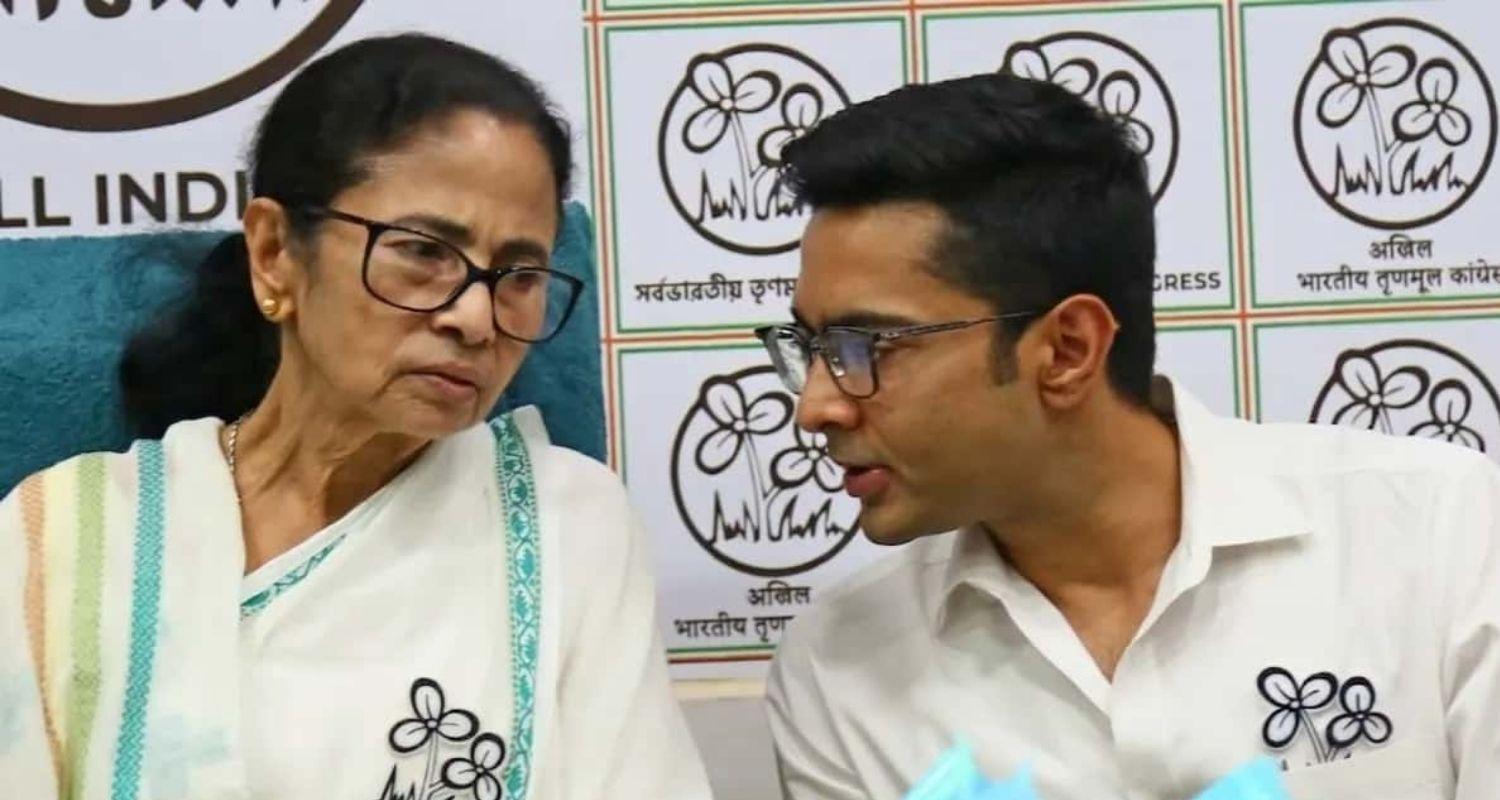
Nearly three decades after its inception, and 15 years into uninterrupted governance, the All India Trinamool Congress has done something it has historically resisted—look inward, and act. The candidate list unveiled by Mamata Banerjee and Abhishek Banerjee is not merely an electoral exercise; it is a carefully calibrated disruption. Seventy-four sitting MLAs dropped. Fifteen reshuffled. One hundred and three new faces inducted. By any political standard, this is not routine pruning—it is structural surgery.
And yet, the anticipated storm has not arrived.
There are murmurs, yes—wounded egos, muted resentment, the occasional symbolic protest played out on social media—but no organised revolt. That absence is telling. It reflects not merely the centralisation of authority within the party, but also the incomplete nature of the purge. For months, speculation hinted at a far more radical overhaul—nearly 100 sitting MLAs, including several ministers, facing the axe. What has emerged instead is a tempered version of that ambition: bold, certainly, but not incendiary. A “goal-line save,” as insiders might call it, preserving equilibrium while still signalling intent.
Make no mistake, however—the imprint of Abhishek Banerjee on this list is unmistakable. This is not just candidate selection; it is doctrine in motion. Performance, not patronage, appears to have been the guiding metric. The long-entrenched culture of lobbying through political backchannels has, at least in principle, been rebuffed. Equally significant is the deliberate retreat from the party’s earlier flirtation with glamour. The conspicuous absence of new entrants from Tollywood marks a symbolic departure from optics-driven politics. Those already embedded—Raj Chakraborty, Sayantika Banerjee, Soham Chakraborty—remain, but the gates have, for now, been shut to fresh celebrity induction.
The exclusions, too, were predictable in parts. Faces like teacher recruitment scam accused Partha Chatterjee were never in contention. Yet, politics rarely adheres to linear logic. The inclusion of ration scam accused Jyotipriya Mallick underscores the enduring complexity of political calculus. A ticket, yes—but not necessarily comfort. A constituency altered, a safety net withdrawn. The message is implicit: survival must now be earned, not assured.
Abhishek Banerjee’s political philosophy, as reflected in this list, is strikingly unambiguous. Electoral politics, in his formulation, demands total immersion—“24-hour politicians,” not part-time aspirants. Constituency performance is paramount. Public image must remain unblemished. These are, in essence, the axioms of his emerging doctrine. Yet, beyond these lie more contentious propositions—“one person, one post,” a potential retirement age—ideas that flirt with idealism in a system often sustained by compromise.
And therein lies the paradox. Political parties, not anchored in ideological frameworks, cannot afford doctrinal purity. They are, by necessity, coalitions of contrasts. As one seasoned observer aptly noted, a party must accommodate both the intellectual refinement of Harvard professor Sugata Bose and the raw grassroots influence of muscleman Anubrata Mondal. To be overly selective is, in politics, to risk irrelevance.
Also read: A legacy under pressure: Mamata Banerjee’s shifting demeanour
It is perhaps this understanding that prevented a total overhaul. What the Trinamool has attempted instead is something more nuanced—a “go slow” reform, punctuated by a decisive jolt. History suggests that enduring transformations are rarely abrupt; they unfold with the quiet persistence of the Earth’s rotation—imperceptible in motion, undeniable in effect. The Trinamool’s challenge is to maintain that balance: to move swiftly enough to signal change, yet cautiously enough to avoid disorientation.
Fifteen years in power breeds fatigue—anti-incumbency, reputational erosion, the sediment of unresolved controversies. The shadow of corruption scandals, the public outrage following incidents like the R.G. Kar episode, and the visible unease among urban voters have collectively created a moment of reckoning. To persist with inertia would have been to invite decline.
Thus, the candidate list is not merely a response—it is a pre-emptive strike against stagnation.
But whether this recalibration will suffice remains an open question. Elections are not decided by intent, but by perception. Will voters embrace these 103 new faces as credible agents of renewal? Or will they remain tethered to the accumulated baggage of the party’s past? By the time results are declared, the electorate will have delivered its verdict—not just on individuals, but on the very premise of reform.
In that sense, this election is as much a test of the voter as it is of the party.
It is also, unmistakably, a trial by fire for Abhishek Banerjee. Having shaped this experiment, he now stands at its centre. The symbolic moment during the candidate announcement—when Mamata Banerjee, mid-way through reading the list, handed over the reins to him—was more than a logistical gesture. It was a quiet transfer of agency, a visual articulation of transition. If this reformist trajectory succeeds, that moment may well be remembered as the genesis of a “New Trinamool.”
For now, however, it remains a gamble—calculated, necessary, but fraught with uncertainty.
The die is cast. The verdict awaits.
By Pranab Mondal

 Follow us