
Trending:
Coup epidemic grips Africa
The cluster of coup attempts follows a broader pattern. Since 2020, there have been 11 successful military takeovers in Africa. The prevalence of military takeovers led United Nations Secretary-General António Guterres to warn as far back as 2021 of a coup “epidemic.” Follow us
News Arena Network - Washington - UPDATED: January 2, 2026, 01:52 PM - 2 min read
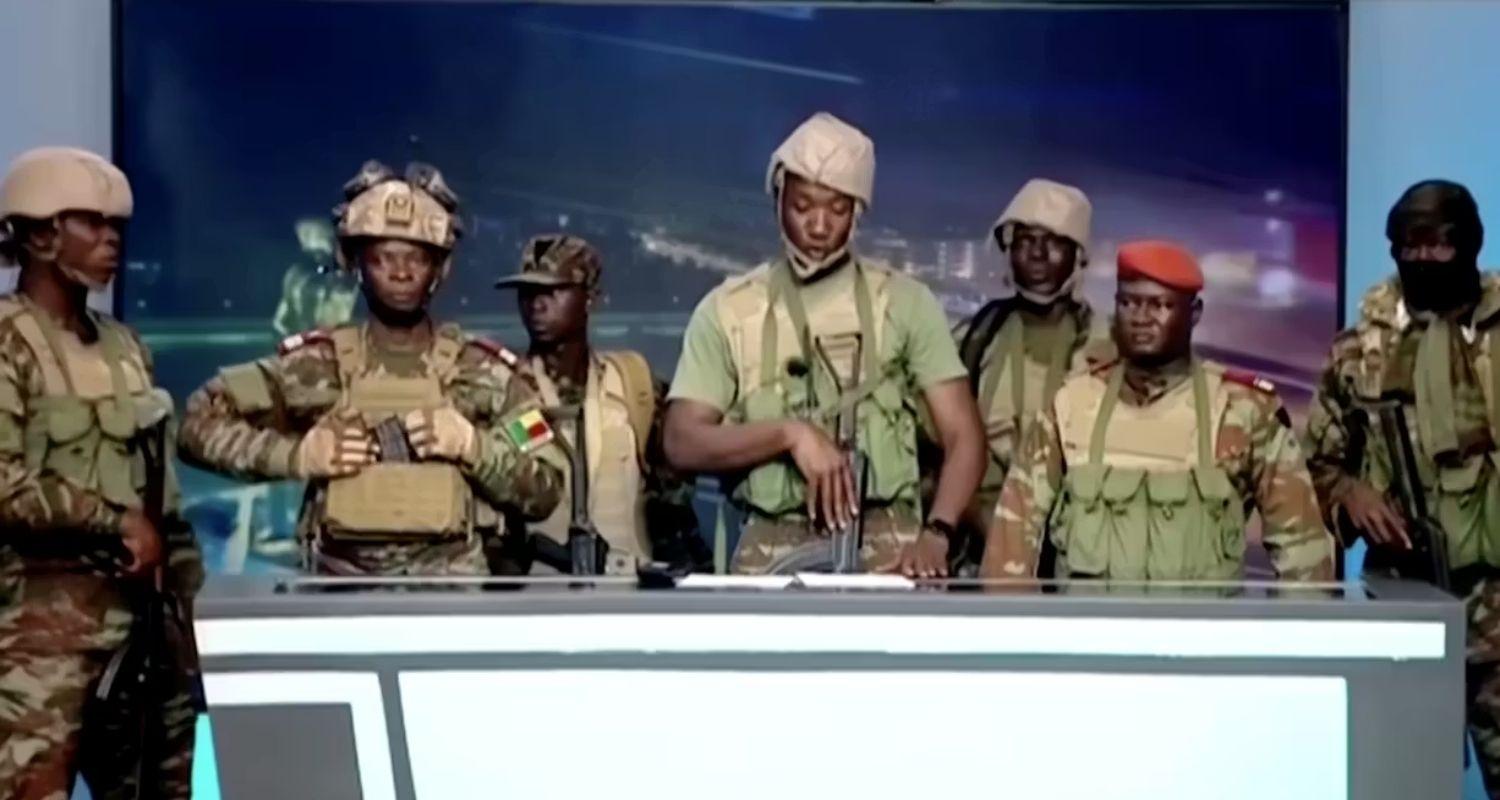
Benin’s coup leaders appear on state TV on December 7, 2025, to announce the suspension of the country’s constitution.
In a scene that has become familiar across parts of Africa of late, a group of armed men in military garb appeared on state TV on December 7, 2025, to announce that they had suspended the constitution and seized control.
This time it was the West African nation of Benin, and the coup was relatively short-lived, with the government regaining full control a day later. But a week before, senior military officers in Guinea-Bissau had more success, deposing President Umaro Sissoco Embaló and effectively annulling the November 23 election in which both Embaló and the main opposition leader had claimed victory. A month earlier it was Madagascar, where a mass Gen-Z uprising led to the elite CAPSAT unit of the Malagasy military ousting President Andry Rajoelina and installing Colonel Michael Randrianirina as leader.
The cluster of coup attempts follows a broader pattern. Since 2020, there have been 11 successful military takeovers in Africa: one each in Guinea, Guinea-Bissau, Niger, Sudan, Chad, Madagascar and Gabon; and two each in Burkina Faso and Mali. Benin represents the fifth failed coup over the same period.
The prevalence of military takeovers led United Nations Secretary-General António Guterres to warn as far back as 2021 of a coup “epidemic.”
But can coups, like the pathogens of many epidemics, be contagious? Observers around the world continue to ask whether a military takeover in one country can influence the likelihood of another one happening elsewhere.
Do coups spread?
Cross-national research offers little firm evidence that a coup in one country directly increases the chances of another. And some scholars remain sceptical that such a phenomenon exists. Political scientist Naunihal Singh, for instance, argues that the recent wave’s coup plotters are drawing less from contemporary events than from their own countries’ long histories of military intervention.
He suggests that any observed regional cluster mostly reflects shared underlying conditions. For example, the countries across the Sahel region that have been the centre of post-2020 African coups share a common set of coup-prone pressures: chronic insecurity driven by insurgencies, weak state capacity and widespread frustration over quality of governance.
Michael Miller and colleagues at George Washington University contend that would-be plotters pay closer attention to domestic dynamics than to foreign coups when deciding whether to move against their own governments.
A new study argues that would-be plotters do indeed pay close attention when contemporaries seize power. A number of dynamics, however, could keep a statistical trend from being realised.
Also read: Nigeria’s numbers are up, but wallets are empty
For one, statistical modelling typically requires contagion to occur within a tight temporal window, often 1 to 3 years.
The findings challenge this approach. A wave of so-called “Free Officers” coups – military takeovers led by junior or mid-ranking nationalist officers, inspired by Egypt’s 1952 Free Officers movement – is a widely invoked example of contagion. The original Free Officers ousted King Farouk and went on to abolish the monarchy and end British influence in Egypt.
However, it took a full six years before a second “Free Officers” coup occurred in the region, in Iraq in 1958.
Rather than blindly follow the lead of Egypt’s coupists, would-be copycats watched closely, took notes and moved only when two factors lined up: the rewards appeared to be worth the risk, and they obtained the ability to make a takeover possible.
In the case of the post-1952 Middle East, the potential “rewards” of emulating Egypt’s Free Officers were not immediately apparent, even in countries with circumstances very similar to Egypt’s.
It wasn’t until the original Free Officers Movement’s leader, Colonel Gamal Abdel Nasser, emerged as a revolutionary icon in the region that others attempted to emulate his success.
As Nasser’s influence grew, the perceived value of a military takeover increased, and Free Officers-inspired plots quickly proliferated against the region’s monarchies. Six years after the Egyptian coup, the first copycat coup succeeded in Iraq, followed by additional successes in Yemen, Libya and Sudan between 1962 and 1969.
The success of one takeover may actually hinder the immediate progress of another. After all, would-be copycats are not the only observers. Vulnerable leaders and their allies can take cues from coups in other countries to try to mitigate their spread at home.
Thwarted conspiracies in Jordan and Saudi Arabia, which were uncovered between 1955 and 1969, demonstrated that while the sentiment to emulate Egypt’s coup was widespread, not all plotters had the capacity to act. Some governments were better prepared to block these attempts. Foreign partners like the United States and Great Britain also played no small role in helping shore up their monarchical allies against coup plots.
Africa’s coup wave
The case of the Free Officers Movement shows that plotters wait for clear signals that a coup is worth the risk. In Africa today, those signals are more immediate, even without a monumental figure like Egypt’s Nasser.
Coupists now see visible domestic support for military takeovers and muted international consequences for those who seize power.
Also read: Sudan's brutal war grinds on
It is increasingly clear that the region has seen a large increase in public support for military rule during this post-2020 wave.
Military coupists like Burkina Faso’s Ibrahim Traoré and Mali’s Assimi Goïta have not only attracted domestic support but also regional popularity.
Data from Afrobarometer illustrate this shift clearly.
In the survey wave that ended in 2013, less than 11 per cent of respondents in Benin said they supported or strongly supported army rule. This nearly doubled to 19 per cent by 2021 and has now tripled, with 1 in 3 people in Benin expressing support for military rule.
These attitudes are reinforced by military leaders’ promises to “clean up” corrupt or ineffective governments.
Highly visible images of cheering pro-military crowds in countries like Niger and Gabon further signal that a takeover can gain public support.
International indifference
The international signals are just as important. From the near-absent reaction to the Zimbabwean military’s removal of Robert Mugabe in 2017 to the lukewarm response to Chad’s military takeover in 2021, these cases suggest that international punishment can be temporary or even non-existent.
The message is reinforced when coup leaders who are initially condemned, like Madagascar’s Randrianirina, later gain acceptance from regional organisations like the South African Development Community. In Guinea-Bissau, attention on last month’s coup has somehow seemed to focus more on President Embaló’s alleged involvement in the coup than on the military’s unconstitutional seizure of power.
But it is more than seizure of power. Contemporary military leaders are staying in power much longer than their predecessors in the early 2000s, either by indefinitely delaying elections or by directly contesting them.
Although the African Union’s framework specifically forbids coup leaders from standing in elections, there has been virtually no consequences for coupists consolidating their rule via elections in places like Chad and Gabon.
This is not lost on would-be plotters, who see their contemporaries seize and legitimise their authority with minimal pushback.
To some degree, the spread of coups depends on how they are received. And in the case of the recent rash of military takeovers in Africa, the international community and domestic policymakers have done little in the way of stemming that spread.
Via The Conversation
