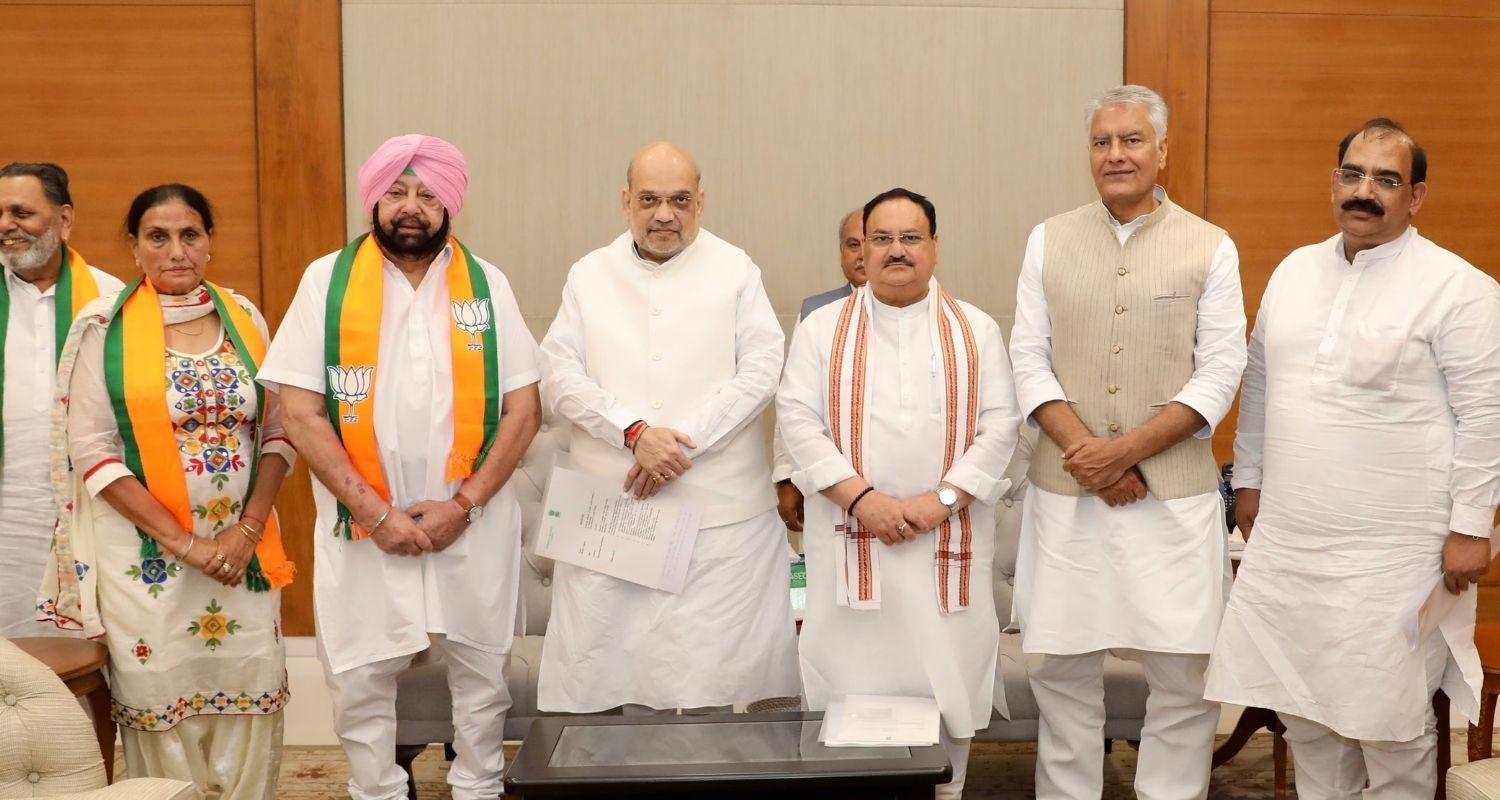
On Sunday, Punjab Bharatiya Janata Party vice-president Arvind Khanna resigned from the party and joined the Shiromani Akali Dal. While this was morale boosting for the Akali Dal, which has been fighting an existential battle, it was a great setback for the BJP, which is trying to expand its base in Punjab and has repeatedly reiterated its position that it will fight the next elections in the state on its own without any alliance.
Khanna leaving the party that he had joined before 2022 assembly elections is quite significant and must be of serious concern for the saffron party. Khanna was among the first who joined the BJP ahead of the 2022 assembly elections. He was followed by other senior Congress leaders like Rana Gurmeet Singh Sodhi, Kewal Singh Dhillon and many others.
All of them contested the 2022 assembly elections on BJP ticket against all odds, when the BJP faced strong resistance and hostile crowds due to the three Central agriculture laws. BJP candidates were not allowed entry into villages. Although none of these leaders could win, all of them got a significant number of votes in the constituencies they contested from.
Going by the last Parliamentary election results when the BJP secured more than 18 per cent popular vote and led from 23 assembly segments in Punjab, the party is definitely on ascendancy in the state. Though the party could not win any of the 13 Parliamentary constituencies, its performance was very good in some seats like Ludhiana, Patiala and Ferozepur, where its candidates lost by narrow margins only.
Also read: Modi pushes BJP's Dalit outreach in Punjab
Despite a substantial vote share of 18.5 per cent—when the Congress and AAP vote share was around 26 per cent each and that of the Akali Dal 13.4 per cent only—the BJP, so far has not positioned itself in strong, assertive and aggressive posture on the ground.
The party leadership, no doubt, is consistently maintaining that it will contest the elections on its own, the sentiment does not seem to translate on the ground in the same measure. The party still has a long way to go to make significant inroads into the countryside. There is no hostility against the BJP as compared to 2022, but there is not much traction either. At best, the rural voters are still indifferent towards the BJP.
The BJP cadres in Punjab are ‘divided’ between the newcomers and traditional workers and leaders. The newcomers, most of whom have joined from the Congress, want the party to be more assertive and aggressive. It is this section that favours an alliance with the Akalis as that seems to be the only option if the party wants to win the elections in Punjab.
But the traditional voters and leaders are adopting the party high command’s line. The insiders maintain that traditional leadership of the party in the state is stuck in the old mind set of having resigned and reconciled to the belief that the BJP cannot form government on its own. Moreover, the state leadership has been enjoying power at the Centre for the last about 12 years. For it continuing as an opposition in the state with government at the Centre, which provides it with a certain degree of leverage in the state, does not seem to be a bad option.
There is also a feeling among the leaders who joined the BJP from outside that they are not being accepted completely in the party. They have a grievance that the traditional BJP workers, in a large number of cases, do not support them wholeheartedly. The BJP will have to address this issue seriously lest it loses a few more leaders in the coming weeks and months. Because, this holds true about all the leaders right from Capt Amarinder Singh and Sunil Jakhar right down to the grassroots. Jakhar, despite being the Punjab president of the party, is far less visible than working president Ashwani Sharma. The way social media handles of the party project Jakhar despite being the state president in comparison to Sharma, is just one of the examples.
Also read: Arvind Khanna switches to Shiromani Akali Dal
Less than a year is left for assembly elections in Punjab, which may be held in February. However, there is a possibility of these being advanced, as there is a possibility of the census being carried out across the country in January/ February next year. That leaves less time for the party to reorganise and position itself.
First thing the party needs to do is to pre-empt any further exodus of its leaders to other parties. The party also faces the challenge to ensure it retains the voter base of 18 per cent. For this, it will have to take a practical and pragmatic view of the ground situation in Punjab.
It will have to take a practical and pragmatic view of the ground situation in Punjab. Going solo will not take the party anywhere. As the party leadership has been consistently insisting about going alone, there is apprehension and uncertainty among the majority of its rank and file about the party’s future and fate.
Not only will it be detrimental to the BJP’s own interests, it will conversely provide a huge advantage to the Congress, particularly in urban areas. The ‘swing voters’ who voted for the BJP during the Parliamentary elections in 2024, have a strong probability of voting for the party they feel is likely to win.
The BJP has to convince this section about its strong chances of victory. For the party the challenge is not only to retain its leaders, but also to ensure that it also retains the voter base of 18 per cent.

 Follow us