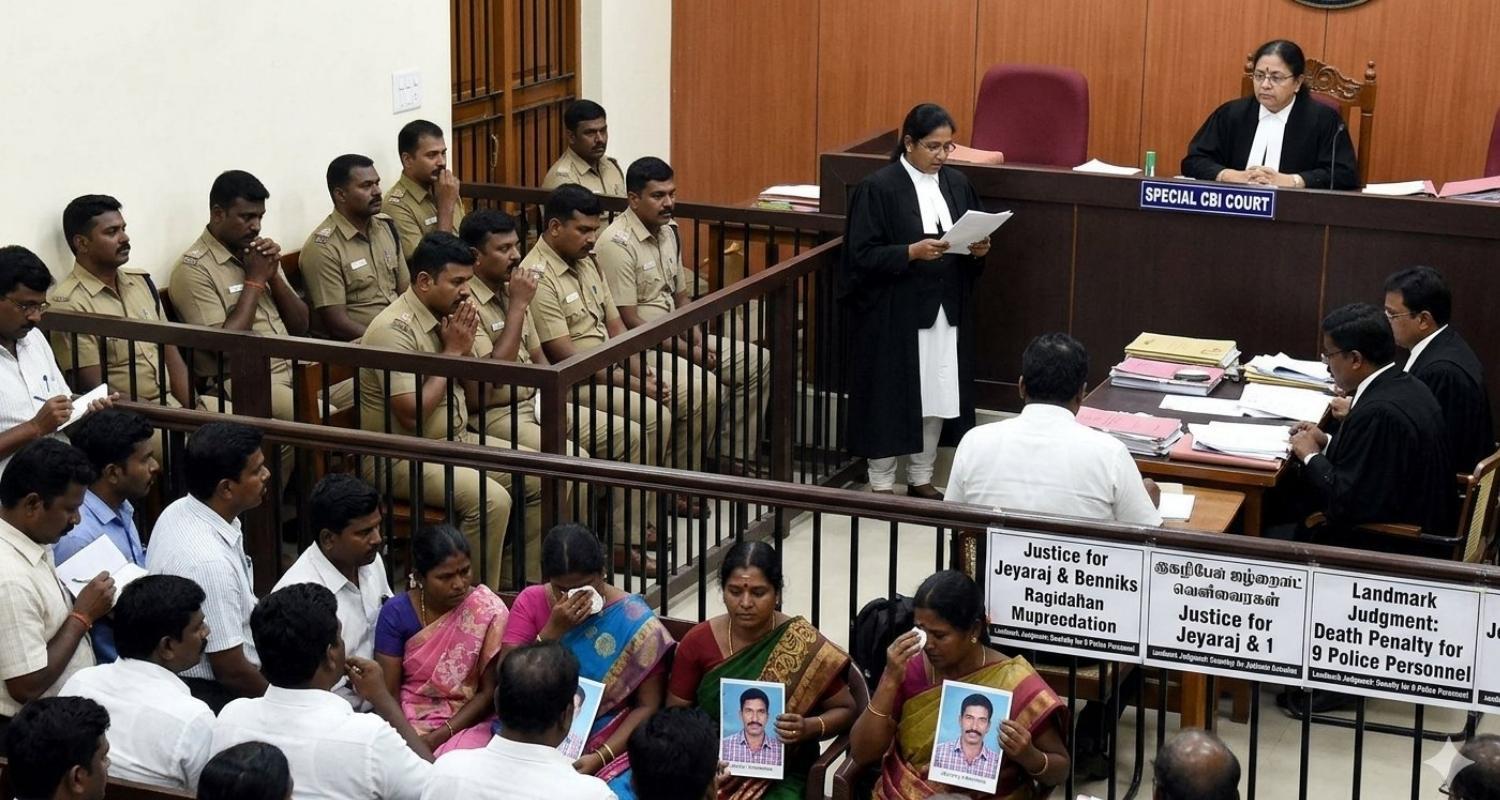
Recently a Madurai court sentenced nine cops for the custodial murder of a father-son duo. The verdict has widely been hailed. The death penalty will need to be ratified by the Madras High Court.
Although the case was actually fast-tracked by the Indian standards, as the death took place in June 2020, it is quite likely that the execution of the sentence may take several years more, if at all it is implemented and if the convicts do not get some relief from the appellate courts.
The particular case is one of the rarest of the rare examples of the macabre and barbaric police brutality in custody. In this case the victims were not even accused of any crime. According to the FIR, the father, Jeyraj, had been detained for alleged violation of the COVID guidelines. When his son Beniks went to the police station, asking why his father was detained, there was reportedly some altercation. Beniks was also detained as the ego of the cops was hurt. And then the cops broke loose hell on the father-son duo that led to their eventual death.
The barbarity and brutality of this killing may hardly have any parallels. After being brutally tortured, the father-son duo was made to wipe off the bloodstains from the walls and furniture with their own clothes. They reportedly bled from their rectums also. Such was the brutality and barbarity of the nature of the torture they were subjected to.
Had it not been for a conscientious woman cop Revathi, who came forward as a witness, the monsters would not have been punished. As often happens with such cases, the Tamil Nadu government had tried to hush up the matter with a routine inquiry. Two cops were suspended and the SHO was transferred. The matter might well have ended up there had Jeyraj and Beniks’ friends and associates not been witness to the brutality. They were waiting outside the police station and had heard the cries and the screams of the torture the entire night.
As they narrated the brutal story of horror to others there was widespread anger and outcry across the mainstream and social media. Eventually, the Madras High Court ordered a CBI inquiry, which finally resulted in the conviction and sentencing of the nine guilty monsters. Hope they get no mercy and are executed for the monstrous murders.
Bringing the guilty cops involved in custodial killings to book is rarest of the rare things to happen in India. The double murder of the father-son duo would have passed off like another murder and the guilty cops would have been back on the job, but for the Madras High Court taking serious note of it and the CBI working diligently and not leaving any loose ends that led to the conviction of the monster cops and eventual sentencing to death.
But how many cases get reported in India? That is a million-dollar question. On an average, five custodial deaths are reported every day across India. These are only the “reported” ones. Many times more cases go unreported and are hushed up. And how often do the culprits get convicted? That is a million-dollar question, as the victims have to fight against the might of the system. In such cases of custodial torture and deaths, the police are both the accused and the prosecutors. Had it not been for the CBI, the cops would have eventually been let off in this case also.
Also read: TN custodial deaths: 9 cops sentenced to death
India does not have any special law against the custodial torture. A bill is pending in the parliament and is waiting to be made into law. Although India is a signatory to the United Nations Convention Against Custodial Torture, it has not ratified the convention for multiple reasons. This is primarily because it might weaken the investigations into the terror related cases and those which involve threats to national security.
The opinion across the country remains divided over fixing accountability of the police. It is quite understandable that while fighting the insurgents or terrorists, cops are placed against heavy odds. When the terrorists do not follow any law, nobody expects the police or the security personnel to use kid gloves to deal with them. Those incidents are understandable.
But what is not acceptable is when the police resort to barbaric brutality against the helpless detainees, who have no voice and no outlet. When any person is detained, he remains at the mercy of the cops, who feel free to use any means and methods to “extract confessions” from the accused.
Despite clear guidelines from the Supreme Court, custodial torture goes unabated. Third degree method is forbidden. But third degree torture is a routine and not an exception during police interrogation of the accused across the country.
India needs stringent law against the custodial torture, and the offence must be made non-bailable with quantum of punishment not less than 10 years. Besides, all the complaints of the custodial torture must automatically be referred to the CBI for investigation, which should be the investigating agency for all custodial torture cases.
The incidents of custodial torture are more rampant than reported. Only the deaths get noticed and not even all deaths. According to the data generated from multiple sources, between 2016 and 2022, India reported about 11,600 custodial deaths. Independent estimates suggest that on an average there are five custodial deaths every day across India. The figure might be higher as not all cases get noticed and reported.
The Supreme Court of India has repeatedly emphasised upon the government for strict compliance of various safeguards against custodial torture. These include medical check-up, recording of statements, access to legal aid and installation of CCTV cameras in all police stations across the country. But the implementation of the guidelines, sadly remains a far cry.

 Follow us