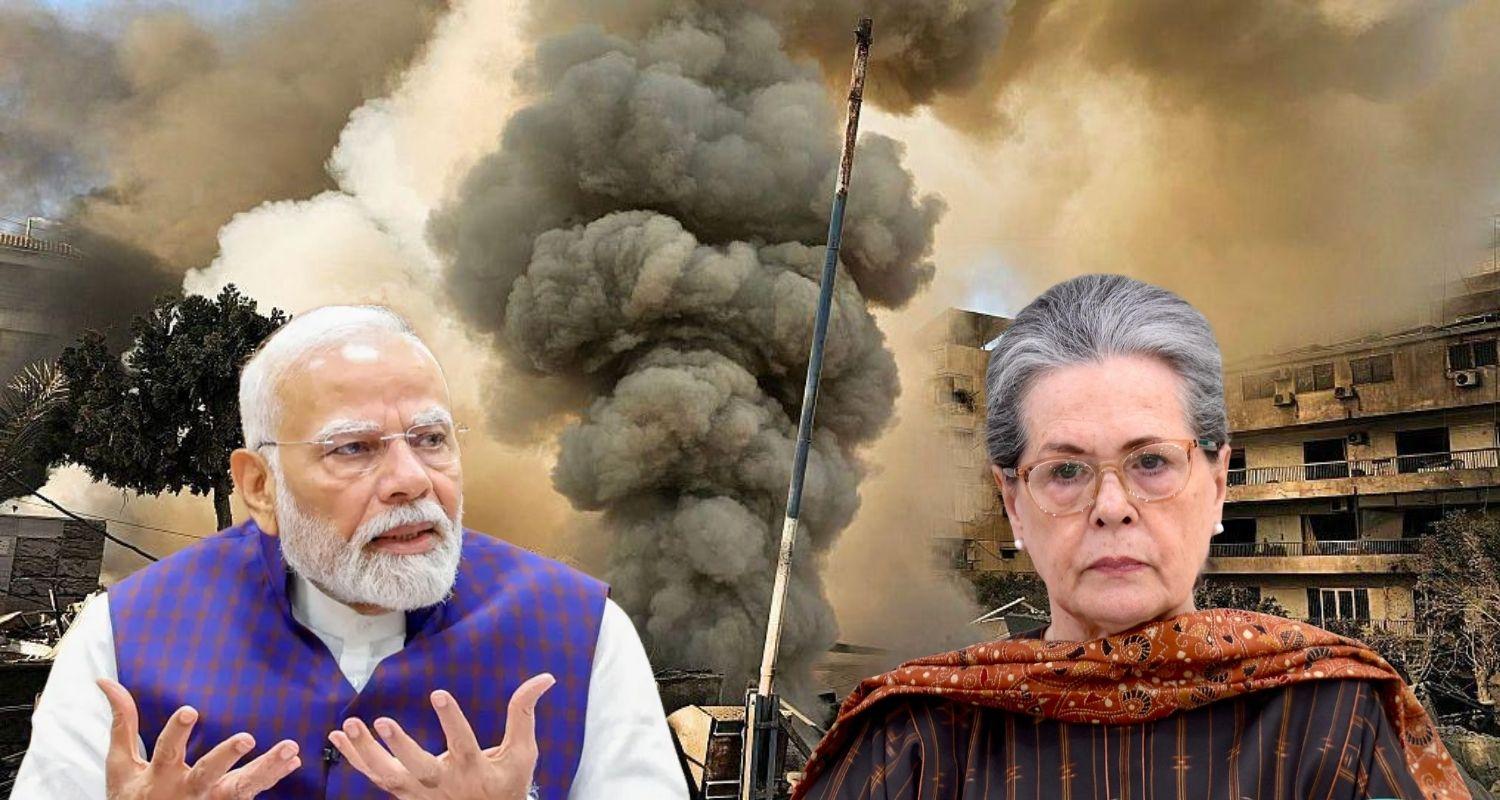
Congress Parliamentary Party chairperson Sonia Gandhi has come out with a scathing attack on the Government of India, Prime Minister Narendra Modi in particular, over the country’s silence on the killing of Iranian supreme leader Ayatollah Khamenei. Gandhi maintained that Modi’s silence does not mean being neutral, but amounts to abdication of moral authority. “At moments when rule-based order is under visible strain, silence is abdication,” she remarked in a newspaper article on Tuesday.
The Congress has taken a “principled” stand and condemned the killing of Khamenei, while the Bharatiya Janata Party as also the Government of India have maintained complete silence. Both the parties have their own reasons for reacting and not reacting. It is as much about domestic politics as it is about “moral grandstanding”. The Congress has obviously taken a stand for domestic reasons than for any diplomatic reasons.
Although not spelt out bluntly, Congress has tried to link Modi’s stand on Iran with “Muslim issue”. This fits well in Congress’ narrative of projecting Modi and the BJP government as being against the Muslims. However, the Congress is badly mistaken if it believes that it was addressing an “Islamic issue”. If Iran is an Islamic country, so are its opponents like Saudi Arabia, United Arab Emirates, Kuwait, Qatar and Bahrain, all of whom are standing with the US and Israel.
India undoubtedly has taken a clear and categorical position where it is seen to have sided with the United States and Israel. The tilt is obvious and understandable. Israel has proved to be a reliable partner. There is no point in antagonising a superpower like America under Donald Trump merely on the matter of “moral principles”, which again are debatable.
As mentioned in these columns earlier, Iran in the recent past had taken a position that was highly and unjustifiably critical of India. Iran had crossed the proverbial red line by commenting against the Abrogation of Article 370 and the Citizens’ Amendment Act. This amounted to clear interference and a critical one at that. Even then, India remained neutral on the issue of conflict between the US-Israel and Iran.
As far as India expressing solidarity with other gulf countries like Saudi Arabia, UAE and others, is concerned, there are multiple reasons for that. Questions are being asked as while India did condemn the attack on their territories, it remained silent on the attack on Iran by the US and Israel. These countries are undoubtedly aligned with the United States, but they did not participate in the war against Iran. There is no justification for attacks on these countries. Interestingly, all of them are Muslim countries only.
Also read: India’s pragmatic take on Iran
Second and more important reason for India to stand by the gulf countries is the huge Indian diaspora living in those countries. The total number of Indians living in these countries, including UAE, Saudi Arabia, Qatar, Kuwait, Bahrain is estimated to be about one crore. India receives massive remittances from its expatriates from the gulf countries, which are estimated to be about $70 billions.
Imagine one crore Indians living in a particular region. Shouldn’t the Prime Minister of their country feel concerned about their safety and security and act accordingly? In comparison, there are hardly any Indians living in Iran. The number of Indians living in Iran is roughly about 10,000.
In current times and circumstances, diplomacy is and should not be guided or driven by supposed moral principles but by practical and pragmatic realities and necessities. India has no reason to take a high moral ground and that too for no reason, when being neutral serves the purpose better. Adopting a neutral stance serves India’s diplomatic interests well, while at the same time it helps to safeguard the interests of about one crore expatriates living and serving in the gulf countries.
While the Congress has taken an unambiguous and categorical stand against Khamenei’s killing, it definitely has endeared itself to a section of the population, but not the entire community. Iran is a Shia majority country and supreme leader Khamenei was the religious head of the entire Shia community living across the world.
An overwhelming majority of Muslims in India belong to the Sunni sect. That is the reason that the protests over Khamenei’s killing were restricted only to places where Shias live, like in Srinagar city of Jammu and Kashmir and Lucknow, which has a considerable population of Shia Muslims.
Countries opposed to Iran, which are also allies of the United States like Saudi Arabia, Qatar, Bahrain or UAE are also Muslim countries, following the Sunni sect. Iran has never got along well with these countries. It is not only because of Iran’s consistent and continuous hegemonic behaviour to assume the role of dominant regional power in the Middle East, but also the deep and historic religious fault-lines that have divided the Sunnis and Shias for centuries, right since the death of Prophet Mohammad that led to struggle for succession and taking over of the Caliphate.

 Follow us