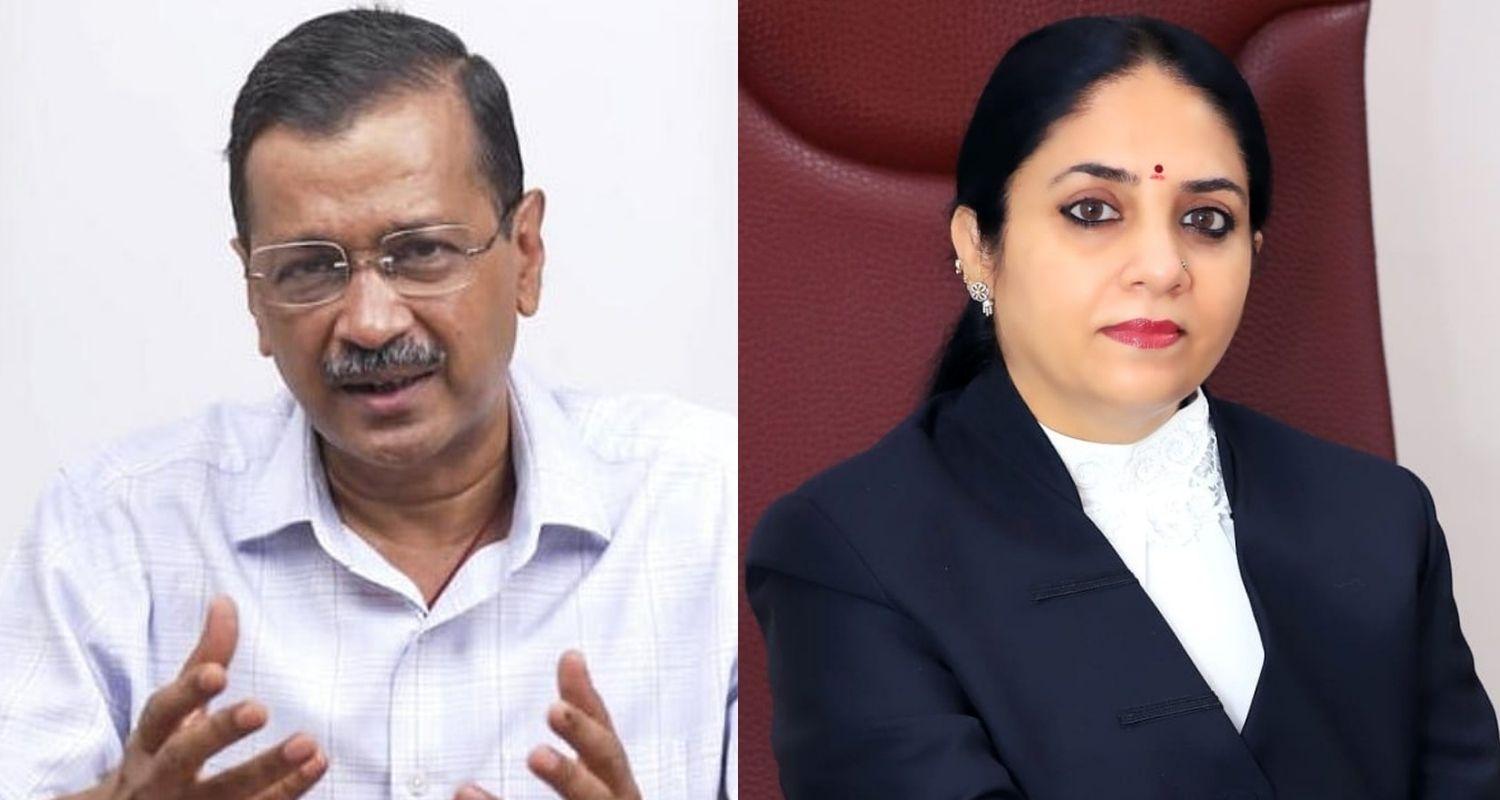
Aam Aadmi Party supremo Arvind Kejriwal has shot off a letter to Delhi High Court judge, Justice Swarana Kanta Sharma, which is no less than a scathing indictment done with a purpose. No matter how much Kejriwal has tried to sugarcoat the letter, fact remains that he has pronounced a judgment on a sitting judge of a high court by questioning and doubting her ability to dispense impartial justice saying there is “grave public doubt on your ability to dispense impartial justice”.
Interestingly, Kejriwal has packaged it in the garb of “Satyagraha” invoking the father of the nation, Mahatma Gandhi. How much respect Kejriwal has for Gandhi and how inspired he feels from him can be judged from the fact that wherever the Aam Aadmi Party came to power, it replaced Gandhi’s portraits with that of Baba Saheb Bhim Rao Ambedkar. There is nothing wrong in installing Dr Ambedkar’s portraits also in the offices, but why remove Gandhi’s. That is self-explanatory, because unlike Dr Ambedkar, Gandhi can no longer fetch you any votes.
It is not for the first time that the AAP supremo has questioned the integrity of an individual. His party’s foundation was laid down on the vicious and malicious campaign against former Prime Minister Dr Manmohan Singh, one of the best prime ministers India had with a scrupulously incorruptible image and reputation. Helped and supported by Dr Singh’s rivals, Kejriwal built a narrative of corruption against his government. None of the charges stood in the courts. But the damage had already been done. Dr Singh was too decent to react or hold Kejriwal in dock like others did.
Kejriwal has a record of tendering unconditional apologies to people against whom he levelled various baseless charges and allegations and who filed defamation suits against him. This list of such people is quite long. They include Akali leader Bikram Singh Majithia, Nitin Gadkari, Arun Jaitley, Kapil Sibal and his son Amit Sibal and an apology also to the Supreme Court of India.
In fact, when Kejriwal apologised to Bikram Majithia, Bhagwant Mann, the current Chief Minister of Punjab, who was then Punjab president of the party, resigned in protest.
When he wrote an open letter to Justice Swarana Kanta Sharma, levelling various charges worded in a smart manner, Kerjiwal was not doing it for the first time. This time he has obviously taken the counsel of some of his legal aides, who have helped him draft this letter in an apparent bid to avoid any contempt of court.
In earlier cases he used unfiltered statements to defame his targets. Since he got away every time with “unconditional apologies”, there is every possibility that when he wrote and circulated the letter to Justice Swarana Kanta Sharma, the “shield of unconditional apology” must have been in the back of his mind. That is his standard way of maligning and defaming people and then tendering an “unconditional apology”.
This time, however, the matter is much more sensitive and serious. In the previous cases where he got away after tendering “unconditional apologies”, the baseless allegations were levelled against political rivals. Normally, politicians ignore such allegations. If everyone takes the allegations seriously, the politicians across the country, irrespective of the party they belong to, will be facing multiple defamation cases.
Also read: Defections expose deep fault lines within AAP
In the current case, Kejriwal has tried to build up a case against the judge of a high court who was hearing his case. This was something unusual and unprecedented that an accused is asking a judge to recuse from his case for no concrete reasons.
He claimed that the judge attended a function of the Akhil Bharatiya Adivakta Parishad, the legal wing of the Rashtriya Swayamsevak Sangh (RSS). Then he claimed that her sons, both advocates, were working under Tushar Mehta, Attorney General of India, who is the prosecutor in the case. There is nothing wrong if the children of a sitting judge are working in the same court.
“A direct and far more serious issue of conflict of interest” that, according to him, “comes from the fact that both of Your Ladyship's children are professionally engaged on multiple advocates' panels of the Union Government.”
He goes on to suggest that since Tushar Mehta, the Solicitor General is the advocate on the opposite side and both her children are directly assigned cases by him and if he assigns more cases to them, they get more fees. He naively seeks to malign her by suggesting that she may favour Mehta since he will provide her children with extra work and make them earn more money.
“The issue of Your Ladyship’s repeated public association with the RSS’s legal front, the Akhil Bharatiya Adhivakta Parishad (ABAP), an organisation belonging to the ideological ecosystem of the ruling dispensation. Politically, we have been the staunchest opponents of the ruling dispensation at the Centre. Ideologically, myself and my party are strongly opposed to RSS ideology. When Your Ladyship has been frequently attending their programmes, how can I hope to get justice from this Hon'ble Court?”
Since the judges are part of the same society and system, they will obviously have associations with different organisations. How can anyone attribute any motive to someone just because s/he is associated with a particular organisation.
Apparently, realising that he could not build up a credible case against Justice Swarana Kanta, Kejriwal resorted to his characteristic way of subjecting his target to a media trial by writing a 2400-word letter to the judge, which is insinuatingly malicious and casts aspersions on her integrity without any concrete evidence and purely on the basis of fanciful assumption; assumption, because she has not pronounced her judgment as yet. Should anyone go to such an extent as Kejriwal did to cast aspersion on the integrity of the judge purely on the basis of assumption and go public about it and subject her to such a media trial?
Kejriwal smartly says he has full faith in judiciary and by writing he has not attacked the institution but has raised objections about an individual. An individual, here in this case a sitting high court judge, is part of the same institution he claims to have full faith in.
“I am left with the painful and inescapable impression that what I had urged as a lawful plea of apprehension was received and answered as a personal attack upon Your Ladyship and as an assault on the institution itself,” Kejriwal claimed in his letter, adding, “my plea of apprehension has been judicially understood as a personal and institutional affront. That understanding itself now makes it impossible for me to believe that I can receive a hearing which appears impartial in this Court.”
While Kerjiwal claims that “my faith in the Constitution of India remains unwavering. My respect for the judiciary remains intact.” He goes on to say, “my objection is not to the institution of the High Court or the larger judicial system, but only to the continuance of this matter before Your Ladyship under a cloud of grave and unresolved questions and circumstances that have generated grave public doubt in your ability to dispense impartial justice. I make this statement with humility, with complete absence of malice, and with sincere regard for Your Ladyship.”
Mark the words “grave public doubt in your ability to dispense impartial justice.”
If Kejriwal has full faith in constitution and respect for judiciary, why did he not go for appeal in the Supreme Court of India? He could have placed the same “apprehensions” before the apex court. Instead he opted out, pronouncing himself to be a “prospective judicial martyr” to some great cause.
Contemptuous.

 Follow us