
Trending:
Stage set for a family political battle in Telangana
The crux of her allegations is that the party responsible for achieving statehood for Telangana had gone into the hands of “crooks and dishonest people” who formed the inner coterie of her father, poisoned his mind, and ultimately damaged the party’s image. Her main targets have been her cousins T. Harish Rao and Santosh Rao, along with her brother KTR. Follow us
News Arena Network - Hyderabad - UPDATED: May 2, 2026, 02:03 PM - 2 min read
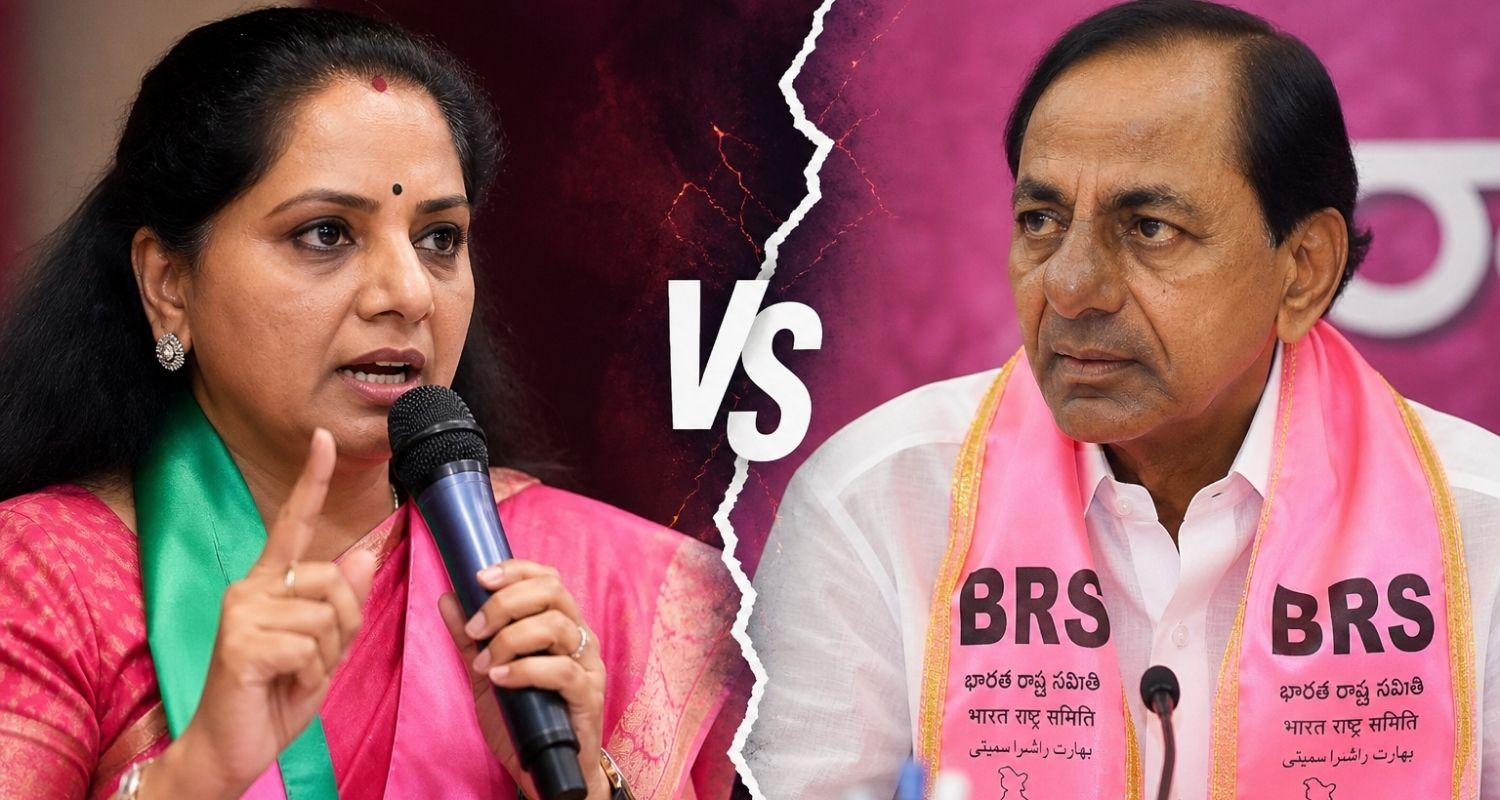
K Kavitha and Bharat Rashtra Samithi (BRS) supremo and former Telangana Chief Minister K. Chandrashekhar Rao.
With the Election Commission giving its nod to the new political party floated by K Kavitha, the estranged daughter of the Bharat Rashtra Samithi (BRS) supremo and former Telangana Chief Minister K. Chandrashekhar Rao, the stage is now set for a bitter family battle that has all the trappings of a tear-jerker soap opera.
An indication of the shape of things to come was available soon after Kavitha, a former MP and MLC who was expelled from the BRS last year for indulging in anti-party activities, announced the launch of her political party last month and, curiously enough, named it “Telangana Rashtra Sena” (TRS), an acronym identical to the original avatar of BRS—the Telangana Rashtra Samithi (TRS). However, it was renamed as BRS in 2022 to reflect KCR’s ambitious plan to expand the party nationwide.
Mocking Kavitha’s move, the BRS asserted that “original is always original”. Taking to the microblogging site X, it shared photos of popular brands of toothpaste and mineral water alongside their fakes to highlight the difference between them.
At the launch of her political outfit, Kavitha spared none, including her father KCR, whom she dubbed “soulless” and a “changed man”. She reserved her choicest epithets for her elder brother and BRS working president K. T. Rama Rao and her cousin and former minister T. Harish Rao.
The crux of her allegations is that the party responsible for achieving statehood for Telangana had gone into the hands of “crooks and dishonest people” who formed the inner coterie of her father, poisoned his mind, and ultimately damaged the party’s image. Her main targets have been her cousins T. Harish Rao and Santosh Rao, along with her brother KTR.
The power struggle within KCR's family, leading to Kavitha’s expulsion, fits into a familiar script of the downfall that dynasty-driven regional parties often face in India. The drama revolves around predictable themes of loyalty, betrayal, power, and pelf.
ECI approval
The Election Commission’s approval for the new party came with a twist. Instead of the ‘Telangana Rashtra Sena’ that Kavitha had announced on April 25, the poll panel has approved the name ‘Telangana Rakshana Sena’.
The ECI asked her to issue public notifications in two national and two local newspapers, informing about the party name approved by the poll body. “Those who have any objections to the proposed party name may send their objections in writing to the ECI within 30 days. Final approval of the party’s name will be subject to the decision on the objections, if any, received by the Commission. Registration will occur only after submitting the relevant documents to the Commission, as per existing guidelines,” the poll panel said.
Fierce fight ahead
The next Assembly elections, due in December 2028, will witness a fierce fight among members of the most prominent political family of Telangana. Already, there are three major contenders for power: Congress, BRS, and BJP.
Kavitha’s political entry is bound to alter electoral dynamics in India’s youngest state. Her campaign, expected to largely target her former colleagues in the BRS and highlight the alleged corruption during its ten-year rule from 2014 to 2023, could inflict major damage on the opposition party and indirectly benefit the ruling Congress.
However, the BRS leadership, which has now hit the reset button and is gearing up for an organisational overhaul, is confident of weathering the storm within the party’s first family and returning to power.
KTR, whose elevation as the party working president and political heir to his father was one of the reasons for the rupture in the family, will now execute the organisational reboot. New committees will be constituted across levels, backed by structured training programmes for cadres. The idea is to sharpen the party’s edge before the next electoral battle.
Equally significant is the membership drive. It will run both online and offline, reflecting a hybrid outreach strategy. However, the focus will be on what is being called qualitative membership. The message is clear: the BRS wants committed foot soldiers, not just a swelling roster.
Twin strategies
The BRS has drawn up a twin-track revival strategy in the state—an organisational reset and leading a mass agitation to expose the misrule of the Congress government.
The regional party is mobilising its cadres for a massive farmers’ rally at Warangal on May 6, timed against the anniversary of Congress’ “Rythu Declaration”. By highlighting procurement delays, fertiliser shortages, and farmer distress, the BRS aims to reclaim the agrarian narrative and sharpen its opposition role. The choice of venue and timing is well calibrated. The event coincides with the anniversary of Congress’ 2022 “Rythu Declaration,” allowing the BRS to reframe the event as a benchmark for accountability rather than promise.
By returning to the same political ground, the BRS is attempting to turn symbolism into a visceral dissection of Congress’ performance on the agriculture front. The convention will be addressed by KTR, who has emerged as the face of the BRS’ renewed offensive.
The Warangal platform is expected to make the party line amply clear while serving as a show of cadre strength. In a crucial move, the BRS has dissolved all its committees except the State Executive, effectively resetting the party’s internal structure. This radical approach is designed to address stagnation, re-energise cadres, and rebuild the party from the grassroots.
Test of credibility
The coming days will prove to be an acid test for Kavitha’s new political venture. For any new political party to gain traction, it must present a compelling narrative and a clear alternative to the prevailing political order. Kavitha, who spent over a decade in the BRS, has held positions such as MP and MLC. As the daughter of KCR, she has also led the socio-cultural organisation ‘Telangana Jagruthi’ since its inception.
While Jagruthi has often been perceived as aligned with the BRS, Kavitha has maintained that she ran it independently. However, differences over policy and internal functioning led to a widening rift between her and the party leadership.
A recurring theme in Kavitha’s political speeches has been the idea of building a ‘socially inclusive’ Telangana. She has consistently emphasised the need for social justice. Her arrest in the Delhi liquor policy case and subsequent legal developments have also shaped her political positioning. Although she has claimed vindication, the case is still under judicial scrutiny.
In the meantime, she has sought to expand her public appeal by aligning with marginalised and disadvantaged sections. Her advocacy spans BC reservations, Dalit rights, women’s representation, recognition for activists, and support for families of martyrs. However, her critics question why many of these concerns were not raised during her tenure within the BRS. They argue that her current stance reflects opportunism.
Beyond slogans, the key question remains what policy framework will underpin her politics. Despite differences in context and circumstances, parallels are being drawn between YS Sharmila, the estranged sister of former Andhra Pradesh Chief Minister Y. S. Jagan Mohan Reddy, and Kavitha. Both emerged from family disputes into independent political ventures.
Similarly, the political positioning of Sharmila, who is the APCC chief, has drawn criticism for targeting opposition parties more than the ruling establishment, raising questions about strategic intent.
Telangana Jagruthi, as a socio-cultural platform, enjoyed a certain degree of public goodwill. It had the potential to function effectively as a pressure group. Transitioning into a political party, however, requires a broader and more cohesive appeal.
Ultimately, the success of Kavitha’s political venture will depend on whether she can articulate and implement a clear, credible, and inclusive social and economic agenda. Without such a framework, the party may struggle to establish itself in a competitive political landscape.
Also read: 'Original is always original': BRS takes a dig at Kavitha's TRS
