
Trending:
US, Israel and Iran using religion to garner support
Leaders across different sides have increasingly drawn on faith to justify their actions. It is rare in recent decades to see political leaders from all three major Abrahamic traditions so openly invoke religious doctrine to legitimise warfare. Follow us
News Arena Network - Washington - UPDATED: March 30, 2026, 04:17 PM - 2 min read
America’s secretary of defense, Pete Hegseth, is known for wearing several tattoos with Christian symbolism, including one that reads ‘Deus Vult’ (“God wills it”), a phrase historically linked to the medieval Crusades. It is perhaps not entirely surprising that while leading a Christian service at the Pentagon on March 25, he used strongly biblical language to describe the war against Iran.
During the service, Hegseth called on God to ‘break the teeth’ of enemies and destroy the ‘wicked’, describing them as undeserving of mercy and fit for ‘eternal damnation’. He framed the conflict in moral and religious terms, asking for ‘clear and righteous targets for violence’, language that suggests a view of the war as having a sacred dimension.
At its core, however, the conflict is not fundamentally religious. Leaders across different sides have increasingly drawn on faith to justify their actions. It is rare in recent decades to see political leaders from all three major Abrahamic traditions so openly invoke religious doctrine to legitimise warfare. The use of scripture and belief by the US and Israel in framing their actions in Iran points to a troubling overlap between religion and rising authoritarian nationalism.
This rhetoric has also intensified tensions with Iran, where political and religious leaders have similarly turned to religious and messianic narratives. Iran, as an Islamic Republic, formally integrates religion into its political system, making such framing more structurally embedded.
Israeli prime minister Benjamin Netanyahu also employed religious imagery when announcing the war on February 28. Referring to the Jewish festival of Purim—which commemorates the thwarting of a plot by the Persian official Haman to destroy the Jewish people—he drew parallels between ancient Persia and present-day Iran. He evoked figures like Mordechai and Queen Esther, suggesting that just as the Jewish people were saved then, so too would they prevail now.
Also read: Battle of narratives over US-Iran ‘ceasefire’
Netanyahu has further compared Iran to the biblical Amalekites—ancient enemies of the Israelites whom, according to scripture, were to be completely destroyed. He has used similar references previously in relation to Hamas, drawing criticism from international bodies such as the United Nations. His government relies in part on religious Zionist allies who frequently use scriptural narratives to defend policy decisions.
In the United States, the First Amendment guarantees religious freedom and prevents the establishment of any one religion. Still, around 70 per cent of Americans identify with a faith, predominantly Christianity, and evangelical movements have gained increasing political influence, particularly within the MAGA movement and under the leadership of Donald Trump.
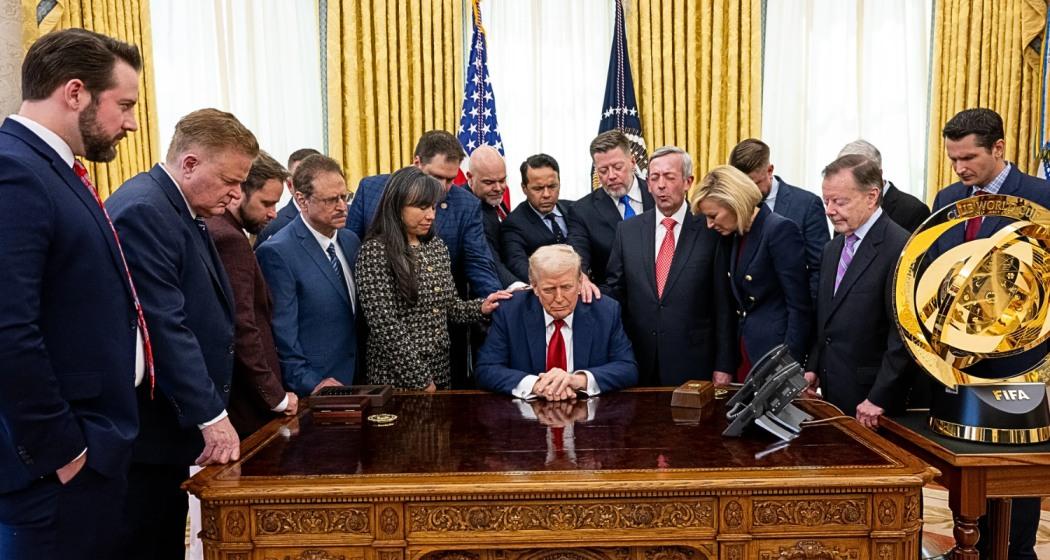
On March 5, Trump participated in a prayer session in the Oval Office with evangelical pastors, who laid hands on him and prayed for divine protection over him and US troops. The footage of the moment circulated widely online, underscoring the visible role of religion in political life during wartime.
Reports also emerged that some US troops were told by commanders that the conflict was part of ‘God’s divine plan’, with claims that Trump had been ‘anointed’ to initiate events leading to Armageddon. Such rhetoric reflects strands of Christian Zionism, a belief among some evangelicals that strengthening Israel will hasten the end times and the return of Jesus.
While evangelical influence has grown globally, not all Christian institutions share this perspective. The Catholic Church, for instance, has strongly criticised the war. Pope Leo, himself American, described the conflict as ‘immoral’ and ‘unjust’, calling it ‘a scandal to the whole human family’, and also condemned attacks affecting Christian communities in Lebanon.
On the Iranian side, the killing of Ali Khamenei marked a significant break from long-standing norms in international relations. It is both a rare assassination of a sitting head of state by a foreign power and an unprecedented killing of a senior Shia Grand Ayatollah.
In response, numerous Shia clerics—some previously critical of Khamenei—declared him a martyr. His successor, Mojtaba Khamenei, invoked themes of martyrdom and messianism in his remarks, referencing the ‘Hidden 12th Imam’, a central figure in Twelver Shia belief who is expected to return at the end of times.
In Iran, Shia messianic belief has long been intertwined with national identity, particularly since the 1979 revolution. Now, clerical leaders are framing the defence of the country as a sacred obligation.
Reactions across the broader Muslim world have been mixed. Some non-Shia leaders, including clerics from Oman’s Ibadi tradition, declared Khamenei a martyr, while Iraq’s Sunni mufti urged Muslims to support Iran. Protests against the war have also taken place in countries such as Pakistan, India, Yemen and Indonesia.
However, other Sunni institutions have been more restrained, reflecting both longstanding sectarian tensions between Sunni and Shia Islam and geopolitical considerations—particularly Iran’s attacks on Sunni-majority nations hosting US military bases.
Across all sides, elements of messianic and apocalyptic belief from Judaism, Christianity and Islam are being drawn into a geopolitical conflict. Although voices within each tradition have criticised this trend, the growing use of religion to justify warfare sets a concerning precedent. While the legality of the war has been widely debated, the instrumentalisation of faith in support of it has received far less scrutiny—something that arguably deserves greater attention.
