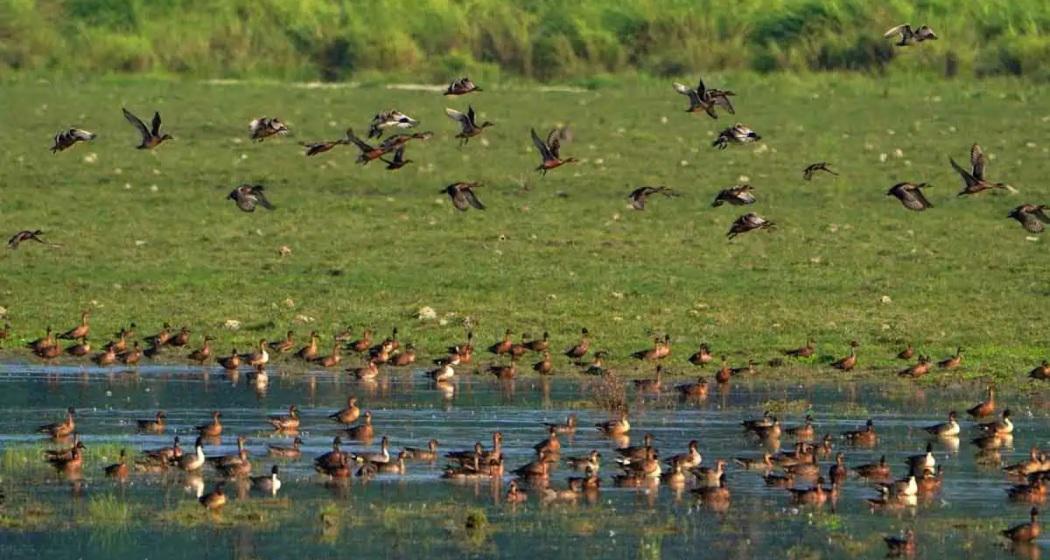
Kaziranga National Park has reaffirmed its status as a premier wintering site for migratory waterbirds, with the seventh annual Kaziranga Waterbird Count recording a total of 105,540 individual water and wetland-dependent birds belonging to 107 species. The week-long synchronised survey, held from 4 to 11 January 2026, encompassed 166 wetlands across 10 ranges in the Eastern Assam Wildlife Division, Biswanath Wildlife Division, and Nagaon Wildlife Division.
Forest officials, ornithologists, students, and volunteers participated in the exercise, which has become a cornerstone of wetland monitoring in the UNESCO World Heritage Site. Dominant species included Bar-headed Geese (with significant numbers contributing to the tally), Northern Pintails, and Lesser Whistling Ducks.
A major highlight was the first-ever documented sighting of the Smew (Mergellus albellus), a rare Eurasian diving duck, which ornithologists noted as potentially indicative of shifting migratory patterns amid broader ecological changes.
Assam Forest Minister Chandra Mohan Patowary described the results as a testament to successful conservation, with the record numbers and rare sighting signalling the effectiveness of habitat protection efforts. The count also documented threatened species, including one Critically Endangered and others listed as Endangered or Vulnerable on the IUCN Red List.
Also read: 54 tigers died in 2025, 10 in 2026: MP HC seeks replies
Rowmari Beel in Laokhowa reported the highest bird concentrations, followed by Donduwa Beel and Sohola wetlands. Larger permanent wetlands hosted greater abundances, while smaller seasonal ones supported higher species diversity.
Since its inception in 2018–19 (when around 10,412 birds were recorded), the survey has shown substantial growth. Key previous figures include:
2025 (6th count): Approximately 112,062 birds across 124 species, a recent peak, with notable sightings of Critically Endangered Baer’s Pochard and Endangered Pallas’s Fish Eagle.
2024 (5th count): 84,839 birds, reflecting a 27% increase (about 18,063 more) from the prior year.
2021–22: 66,776 wetland birds within the Kaziranga Tiger Reserve area.
These trends demonstrate overall progress in bird numbers and diversity, bolstered by expanded coverage and three years of CSR support from Numaligarh Refinery Limited.
Officials stress that protecting Kaziranga’s floodplain wetlands remains essential, as they provide crucial refuelling stops along the Central Asian Flyway for migratory species. Ongoing priorities include maintaining water quality, preventing encroachment, and mitigating disturbances to sustain this biodiversity hotspot.

 Follow us