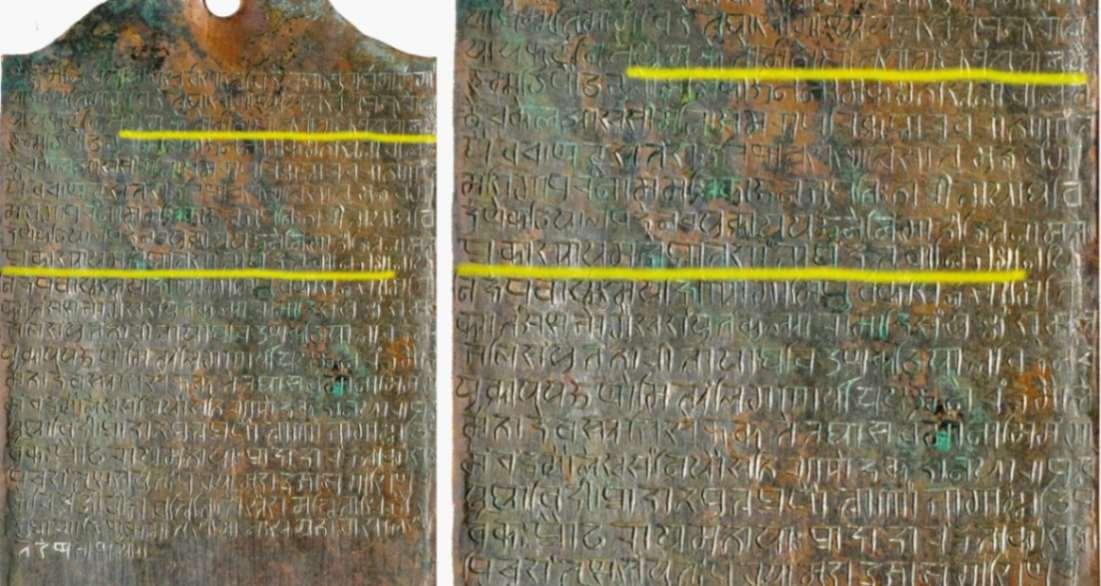
In a major archaeological discovery, a 15th-century copper plate inscription, unearthed at Srisailam temple in Andhra Pradesh, has revealed the first known Indian epigraphical reference to Halley’s Comet. Known for its bright tail and predictable return every 75-76 years, Halley’s Comet is the only short-period comet visible to the naked eye, often feared as a harbinger of doom in ancient times.
The find offers not only a glimpse into the astronomical awareness of the time but also the cultural anxiety such events once stirred. Dated June 28,1456 CE (Corresponding to Śaka 1378, Āshāḍha ba.11) during the reign of Vijayanagara king Mallikārjuna, the inscription is written in Sanskrit using Nāgari script.
It records a royal grant made to Liṁgaṇārya, a Vedic scholar from Kaḍiyalapura (present-day Kadapa district), in response to the ominous appearance of a comet and the accompanying meteor shower. "The inscription provides insight into the cultural and astronomical understanding of comets during the Vijayanagar period,” said Dr K Munirathnam, the Director of the Epigraphy Branch of the Archaeological Survey of India.
Also read: PM Modi hails Andhra on creating Guinness record for yoga event
The copper plate mentions that the land grant was made to mitigate the great calamity believed to arise due to the appearance of a comet (dhūmakētu mahōtpāta śāntyartham) and the associated meteor shower (Prakāśyāya mahōtpāta śāntyartham). The recipient of the grant was the resident of an ‘agrahāra’ (tax-free village) named Simgapura in Kelajhasima of Hastinavati Vemṭhe (believed to be modern Kaḍiyapulanka in Kadapa district).
The inscription reflects the traditional view that comets and meteor showers were inauspicious omens, often seen as harbingers of calamity.
The phrase: “Prakāśyāya mahōtpāta śāntyartham dattavān vibhuḥ” reinforces the idea that the grant was made to pacify the possible disastrous effects associated with the comet.
Significance of the discovery
This was the first epigraphical evidence from India directly referring to Halley’s Comet. It strengthens the understanding that astronomical phenomena were carefully recorded and interpreted in medieval Indian society.
The discovery was made during a meticulous review of unpublished copper plate charters. The collection consists of 78 copper leaves, which are set to be published in book form. This publication will provide further vital information about the historical and cultural context of the Vijayanagara period.
The inscription reflects how celestial events influenced royal decisions and religious grants in traditional Indian polity. The discovery opens up new avenues for interdisciplinary studies involving epigraphy, history of science, and cultural astronomy.
“Interestingly, there is corroborative literature in Egypt and China referring to a similar kind of phenomenon. Additionally, there was a reference to the same comet in Kashmir as well, where a Sanskrit scholar took it as a premonition for the downfall of the Sultans,” Munirathnam said.
The Copper inscription reveals the kind of furore the Comet’s sighting caused in India. The kings and scholars were panicked, viewing it as an ill omen. As is the case with King Mallikarjuna, he ordered several rites and Homams to take place in the kingdom to prevent any negative effects on his kingdom. It underscores how celestial phenomena were woven into the fabric of ritual, belief, and governance in medieval India.
Also read: FIR against Jagan for running over YSRCP party supporter
Halley’s Comet is a periodic comet that appears approximately every 76 years. It is named after Edmond Halley, who correctly predicted its return using Newton’s laws of motion in the 18th century. The 1456 CE apparition was widely observed and feared across Europe, the Middle East, and Asia, including the Ottoman Empire and now, as shown, India. Historically, comets were interpreted as omens of political or social upheaval. The appearance in 1456 coincided with significant global events, including the Siege of Belgrade and upheavals within regional kingdoms.
The Mallokarjuna Swamy temple, where the inscription was unearthed, is located in Srisailam, Nandyal district, on the banks of the Krishna River.
It is one of the twelve Jyotirlinga temples dedicated to Lord Shiva, and also one of the eighteen Maha Shakti Peethas. Known as Sri Bhramaramba Mallikarjuna Temple, it is dedicated to Lord Mallikarjuna (Shiva) and Goddess Bhramaramba (Parvati). The temple has ancient origins, with inscriptions and patronage from dynasties like the Chalukyas, Kakatiyas, and Vijayanagara empire.

 Follow us