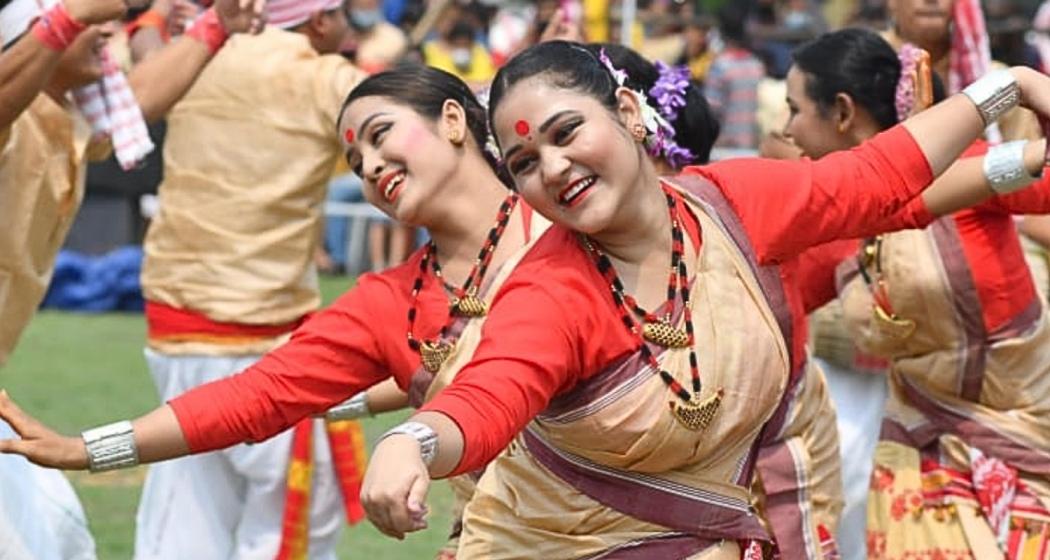
The first day of Bohag Bihu, Assam’s spring festival marking the Assamese New Year, was celebrated across the state on Tuesday with region-specific traditions reflecting its agrarian roots and cultural diversity.
From the mud-filled fields of Titabor in Jorhat to open-air festivities under tree canopies in Digboi, communities marked the occasion with rituals passed down through generations.
In Mahimabari village in Titabor, locals observed Boka Bihu, a distinctive and agriculture-linked tradition practised ahead of the sowing season. Villagers gathered early in the morning and took part in mud-based games, smearing themselves with soil, a gesture they say honours the land they depend on.
“This is a tradition closely associated with our farming life. We depend on the land, and by playing with mud on the first day of Bohag Bihu, we show respect to it,” a resident said.
The practice is also rooted in local belief that contact with soil on the day helps cure bodily ailments. Residents said the tradition has been followed in the village for over five decades, underscoring its continuity across generations.
Also read: 40 lakh women to get ₹9,000 under Orunodoi scheme: Himanta
Boka Bihu is part of a broader “seven-generation tradition” observed in parts of Assam, with similar customs reported from regions such as Majuli.
In Upper Assam’s Digboi, celebrations took on a different form with Gos tolo’r Bihu at Tingirai, where people gathered under trees to celebrate with music, dance and community feasts.
The festivities began with tributes to Assamese cultural icon Zubeen Garg, followed by traditional Bihu husori performances, in which groups visit households to sing and dance while offering festive greetings.
Young men, women and children participated in large numbers, dancing to the beats of dhol and pepa, instruments synonymous with Bihu celebrations.
Traditional games such as koni juj (egg fight) and hah dhora (duck catching) were also organised, adding to the festive atmosphere.
Across regions, Bohag Bihu, also known as Rongali Bihu, continues to reflect Assam’s agricultural rhythms and community life, with variations in practice highlighting both local identity and shared cultural heritage.



 Follow us