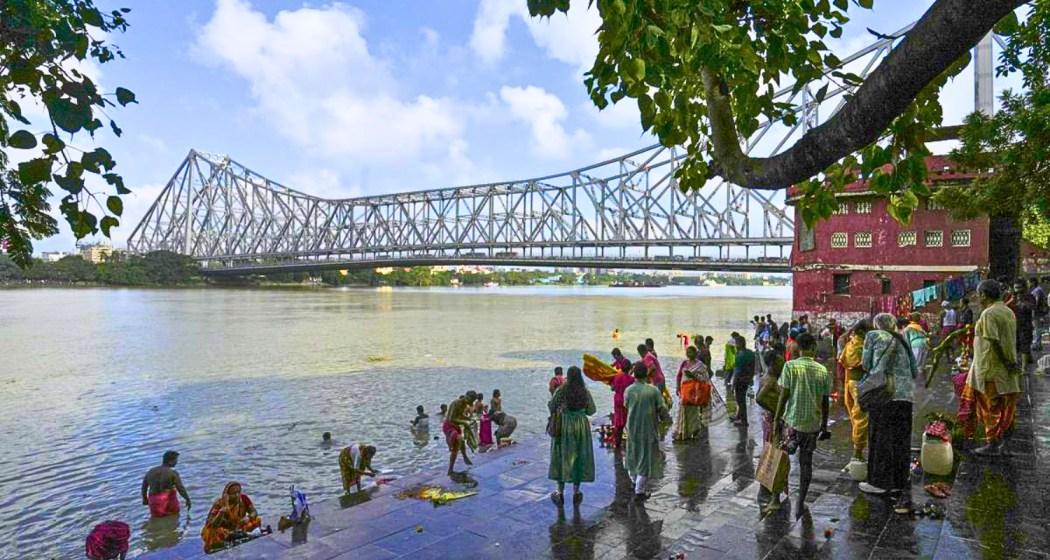
Officials from the National Mission for Clean Ganga on Thursday maintained that West Bengal has witnessed a significant improvement in pollution levels in the Ganga despite being the last main-stem state through which the river flows before entering the sea and carrying the cumulative sewage and industrial load from upstream states.
In a post on X, the Namami Gange mission said the final stretch of the river in Bengal “carries everything” discharged into the Ganga basin from the Himalayas downstream through densely populated urban and industrial centres.
“The Ganga’s last stretch carries everything. By the time the river reaches West Bengal, it is carrying the cumulative load of every state upstream, every city, every drain, all the way from the Himalayas,” the mission said.
“And this is the stretch that has improved the most,” it added.
Citing the Central Pollution Control Board’s Polluted River Stretches assessment, the mission said the Triveni-to-Diamond Harbour stretch was categorised as a “Priority III” polluted stretch in 2018.
According to the CPCB’s 2025 assessment, the identified polluted stretch has now shifted to Baharampore-to-Diamond Harbour and falls under the lower “Priority V” category.
Namami Gange said that although the flagged stretch now appears geographically longer, the actual pollution load in the river has declined considerably.
“That sounds counterintuitive until you read it correctly: a longer line on the map, but far less pollution in the water,” the mission said.
The lower Baharampore-to-Diamond Harbour stretch passes through the densely populated Kolkata-Howrah urban agglomeration, one of the largest urban clusters along the Ganga basin.
“A Priority V rating there, after the Ganga has absorbed everything from upstream, is meaningfully better than where the river stood in 2018,” it added.
Rs 5,028 crore sewage projects sanctioned
The mission attributed the improvement to large-scale sewage infrastructure development under the Namami Gange programme in Bengal.
According to the mission, 34 sewage infrastructure projects worth Rs 5,028 crore have been sanctioned in the state with a total sewage treatment capacity of 816 MLD (million litres per day).
Of these, 17 projects with a combined treatment capacity of 558.5 MLD have already been completed.
The projects are concentrated largely along the Hooghly belt, which receives heavy urban discharge from the Kolkata metropolitan region and adjoining towns.
Also read: Uttarakhand’s Ganga stretch free of pollution: Patil
Among the major projects commissioned during FY 2025-26 are the 35-MLD Maheshtala Sewage Treatment Plant built at Rs 287 crore, the 30-MLD North Barrackpore STP costing Rs 154 crore, the 13-MLD Jangipur STP built at Rs 68.47 crore and the 15-MLD Chakdah STP constructed at Rs 121.66 crore.
The mission also highlighted the increasing adoption of the Hybrid Annuity Model (HAM), under which private operators build and maintain treatment plants with payments linked to long-term operational performance.
East Kolkata Wetland remains key ecological asset
Namami Gange also highlighted the role of the East Kolkata Wetland, describing it as one of the world’s largest functioning natural wastewater treatment ecosystems.
“The East Kolkata Wetland treats roughly 750 MLD of the city’s sewage naturally, using fish ponds, paddy fields and bacterial action, before the water even reaches the Hooghly,” the mission said.
The Ramsar-recognised wetland supports fisheries and agriculture while naturally filtering wastewater entering the river system.
The mission further said West Bengal’s Safe Reuse of Treated Water Policy is expected to be notified within the next two months.
“The last stretch carries the most. And the work shows,” Namami Gange said.

 Follow us