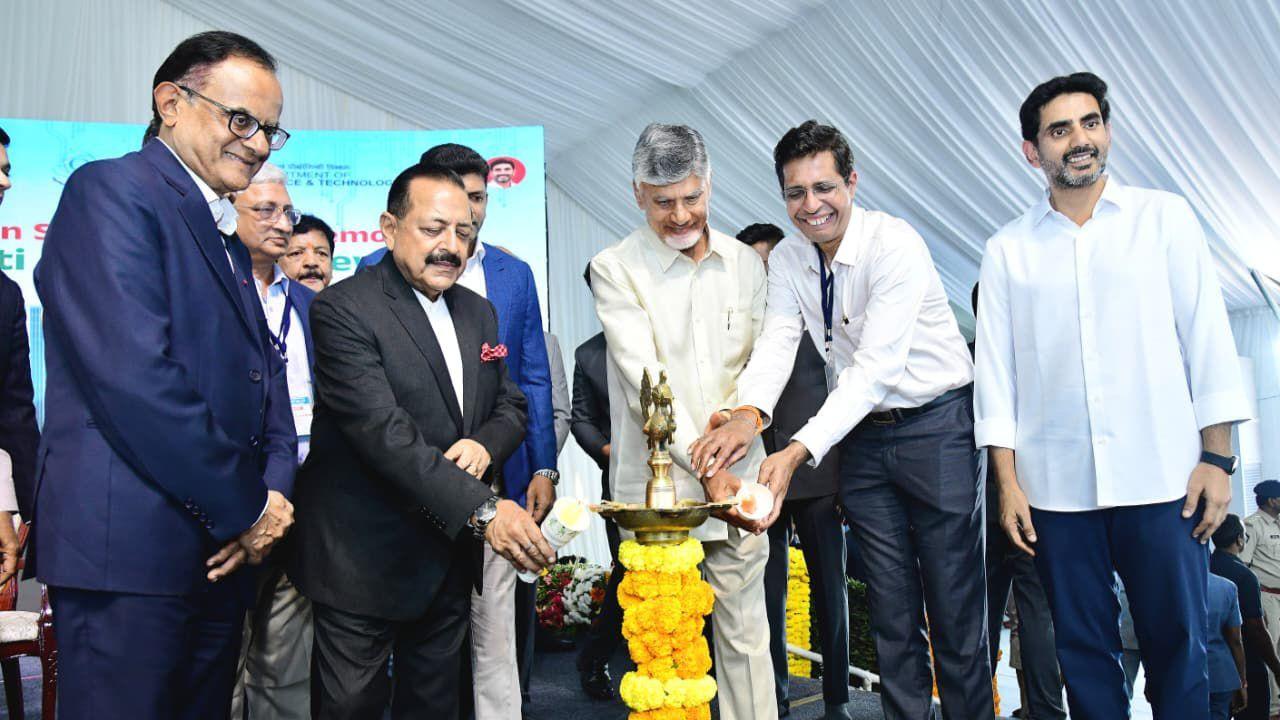
In a major initiative to boost India’s quantum technology aspirations, Andhra Pradesh Chief Minister Nara Chandrababu Naidu and Union Minister of State for Science & Technology, Dr Jitendra Singh laid the foundation stone for Amaravati Quantum Valley (AQV), marking the birth of one of the largest integrated quantum technology ecosystem.
Coming up in 50 acres of land in Uddandarayunipalem of Amaravati, AQV is India's first comprehensive quantum ecosystem where quantum computing hardware will be deployed, software is developed, algorithms are optimized, and world-class talent is nurtured — all within a single integrated campus.
Pending regulatory approval from the United States government, the initiative plans to host an IBM Quantum System Two, which would make it home to India's most advanced IBM quantum computer that is currently available.
With over 50 organizations involved including IBM, TCS, L&T, CDAC, CDOT and leading quantum start-ups, AQV is positioned to become one of the world's Top 5 Quantum Hubs.
Speaking after laying the foundation, Chandrababu Naidu said AP had secured the Centre's Quantum Mission and in a very short time, companies like IBM, TCS, and L&T have come forward to set up quantum computers in AP.
“From December 2026, the first quantum computer in AP will start operating. We have also initiated efforts to manufacture quantum computers. We aim to produce 85% of quantum computing equipment domestically and export it to the country and the world,” Naidu said.
The event also marked the operational launch of the Quantum Innovation Centre, positioning the state’s capital region as the fulcrum for India’s quantum computing thrust.
Singh hailed the initiative as the formal start of India’s quantum journey from Amaravati. He linked the project to Prime Minister Narendra Modi’s National Quantum Mission, backed by a Rs 6,000 crore outlay, which aims to help India acquire global leadership.
Quantum computing, he emphasised, promised transformative applications in cybersecurity, healthcare, agriculture, drug discovery, climate modelling, and national security—fields where exponential processing power could solve previously intractable problems.
Naidu announced plans for a fully functional quantum centre in the capital region by December 2026, with two indigenous systems launching as reference facilities at SRM University on 14 April (World Quantum Day). Major industry players — IBM, Tata Consultancy Services (TCS), and Larsen & Toubro (L&T) — have committed partnerships to develop India’s first 133-qubit quantum computer centre.
Naidu outlined his ambition to manufacture 85 percent of quantum components locally for global export, shifting the state from technology consumer to producer of high-value hardware and intellectual property.
Spanning 50 acres, AQV will integrate research, innovation, hardware testbeds, quantum cloud access, including India’s first non-IBM quantum cloud, and talent pipelines.
Naidu cited 2.08 lakh students having already registered for IIT Madras quantum courses and IBM’s pledge to train 50 lakh youth nationwide in Quantum AI and cybersecurity, with 10 lakh from Andhra Pradesh. He projected India needing 2.5 lakh quantum professionals by 2030, positioning Andhra Pradesh to capture a significant share through large-scale skilling.
Complementing quantum efforts, Naidu announced an Artificial Intelligence University inauguration later this month alongside AI living labs, space city, drone city, electronics city, med-tech clusters, and semiconductor zones.
These converge at the intersection of AI, quantum, and emerging tech, enabling applications in green hydrogen, agriculture optimisation, secure communications, and more.
An inclusive touch was the use of BHASHINI AI-driven translation tools for real-time Telugu rendering of speeches, broadening access to farmers, students, and local stakeholders.
Also read: Andhra govt to set up AI Living Labs Foundation

 Follow us