


Trending:
Gopiballavpur: Lotus blooms in Junglemahal as BJP tests TMC grip
BJP’s growing presence in Junglemahal’s Gopiballavpur signals a shifting political landscape, posing a challenge to TMC’s traditional stronghold. Follow us
News Arena Network - Jhargram - UPDATED: April 16, 2026, 07:16 PM - 2 min read
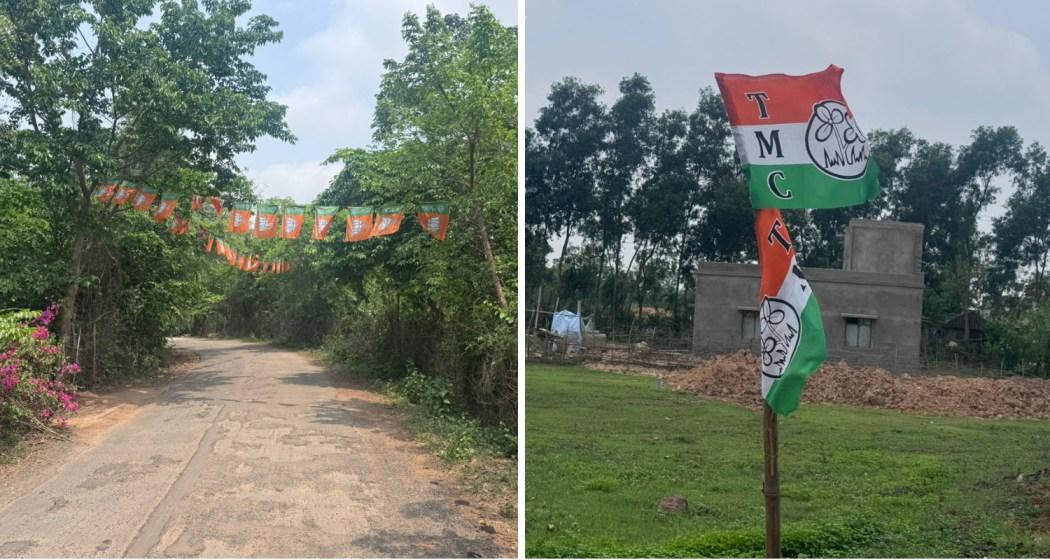
BJP flags displayed along a village road in Kultikri; a TMC flag seen on the way to Gopiballavpur (R).
Under the blazing April sun, saffron flags flutter defiantly along the road constructed under PM Gram Sadak Yojana in Gopiballavpur constituency, signalling a shifting political undercurrent in West Bengal’s western frontier. In Jhargram district—once a Maoist stronghold and later a bastion of the ruling Trinamool Congress (TMC)—the electoral mood is palpably charged as the state inches closer to the West Bengal Assembly election.
What was once an unquestioned sea of green in the 2021 Assembly polls now bears visible streaks of saffron. The Bharatiya Janata Party’s lotus symbol blooms not only in roadside waterbodies but also on mud walls of huts, while its flags hang from trees and electric poles, marking an aggressive push into a region long considered politically distant from its sphere of influence. As temperatures soar in this backward yet strategically crucial belt, so too does the intensity of the political contest—setting the stage for a fierce electoral battle in a terrain that has historically shaped, and been shaped by, shifting power equations in the state.
At the bustling Kultikri market, amid the hum of political mobilisation, 24-year-old graduate Jayanta Mahato was busy operating his battery-powered sugarcane juice machine, serving a steady stream of customers—many of them TMC supporters who had gathered for a rally addressed by the party’s second-in-command, Abhishek Banerjee. Yet, even as his hands remained occupied, his eyes told another story—keenly scanning the crowd, assessing not just numbers but its very composition.
“I am a local resident. The crowd is not from our area,” he remarked, with a quiet certainty that belied his age. According to him, people had been ferried in from Nayagram, Jhargram and Kharagpur in buses and other vehicles. “It is not a show of support; it is a show of strength in terms of footfall,” he added, suggesting a carefully orchestrated display rather than organic mobilisation.
Jayanta’s political observations reflect a shifting undercurrent in Gopiballavpur. In the 2021 Assembly elections, the BJP had struggled to even field a credible candidate, leaving little impression on voters like him. “That is why I voted for the TMC,” he admitted. This time, however, he perceives a stark contrast. The BJP’s early announcement of Rajesh Mahato—a familiar face in the region—has, in his view, lent the party an organisational edge. In comparison, the ruling party’s decision to drop sitting MLA Khagendranath Mahato, who had secured victory by over 24,000 votes, and replace him with a new candidate, Ajit Mahato, signals possible internal dissatisfaction. “Changing the candidate sends a negative message about the previous MLA’s performance—it damages the party’s image,” he observed with disarming candour.
Also read: Time to end 15-yr deadlock, build developed Bengal: Modi
Beyond electoral arithmetic, Jayanta’s personal story mirrors a deeper crisis. Forced to abandon his dream of polytechnic studies midway, he now grapples with the harsh realities of unemployment in what he describes as an “industry-starved” region. “What will I do with a degree? Who will give me a job?” he asked, articulating a question that resonates with a growing class of educated yet unemployed youth. Even migration to urban centres offers little certainty, he fears.
In many ways, Jayanta embodies the restless, aspirational, yet disillusioned youth of Bengal—caught between political spectacle and economic stagnation. His assessment of a tightening contest in Gopiballavpur may well prove prescient, as shifting loyalties and simmering discontent threaten to redraw the constituency’s electoral landscape in the upcoming polls.
After two consecutive terms in power, the Mamata Banerjee-led TMC in Gopiballavpur witnessed a perceptible dent in its electoral dominance in 2021, with its vote share dipping by around four percentage points. The BJP, in contrast, scripted a dramatic surge—garnering 40.36 per cent of the vote share, a staggering jump of nearly 28 percentage points that fundamentally altered the region’s political landscape.
Among the thousands of faces at Thursday’s rally addressed by Abhishek was Renubala Soren, a resident of Dhonkamra village, nearly 40 km from the event venue. While the TMC continues to project its flagship Lakshmir Bhandar scheme—offering a monthly assistance of Rs 1,500 and Rs 1,700—as a cornerstone of its welfare politics, Renubala’s lived reality presents a more complex picture.
“I receive the monthly grant, but my husband has no steady work to sustain our four-member family,” she said, her voice reflecting quiet resignation. A daily wage labourer without land ownership, her husband’s livelihood remains precarious and heavily dependent on seasonal agricultural work. “Except during the monsoon, work is scarce. There is no proper irrigation in our area,” she added, underscoring the structural economic distress that persists beneath the veneer of welfare outreach. She also acknowledged that local TMC functionaries had instructed residents to board buses and attend the rally—hinting at the orchestrated nature of political mobilisation.
The socio-political arithmetic of Gopiballavpur suggests an election poised on a knife’s edge. With approximately 40 per cent Kurmi voters, 25 per cent Scheduled Tribes, and 18.5 per cent Scheduled Castes, the constituency’s demography is both diverse and decisive. Historically, backward class voters have played a pivotal role in determining electoral outcomes—and this time, the BJP is banking heavily on this equation. Its candidate, Rajesh Mahato, a prominent Kurmi leader, is expected to consolidate significant support within the community.
“Like the rest of Bengal, Gopiballavpur will witness a bipolar contest,” Rajesh asserted confidently. “We are not relying solely on Kurmi votes. This time, SCs and STs will also back us, having realised the ruling party’s incompetence and corruption.”
However, TMC candidate Ajit Mahato dismissed these claims, attributing the BJP’s 2021 performance to the erosion of the Left’s traditional vote base. “The BJP’s rise was largely due to the decline of the CPM,” he argued. “Their divisive politics and the ongoing SIR exercise will not sustain in Bengal. We remain confident of the people’s mandate, driven by the welfare initiatives of Mamata Banerjee.”
As the electoral narrative sharpens, Gopiballavpur stands as a microcosm of Bengal’s evolving political conflict—where welfare promises, identity equations, and grassroots discontent are set to collide in what could emerge as one of the most closely watched contests in the upcoming Assembly elections.
