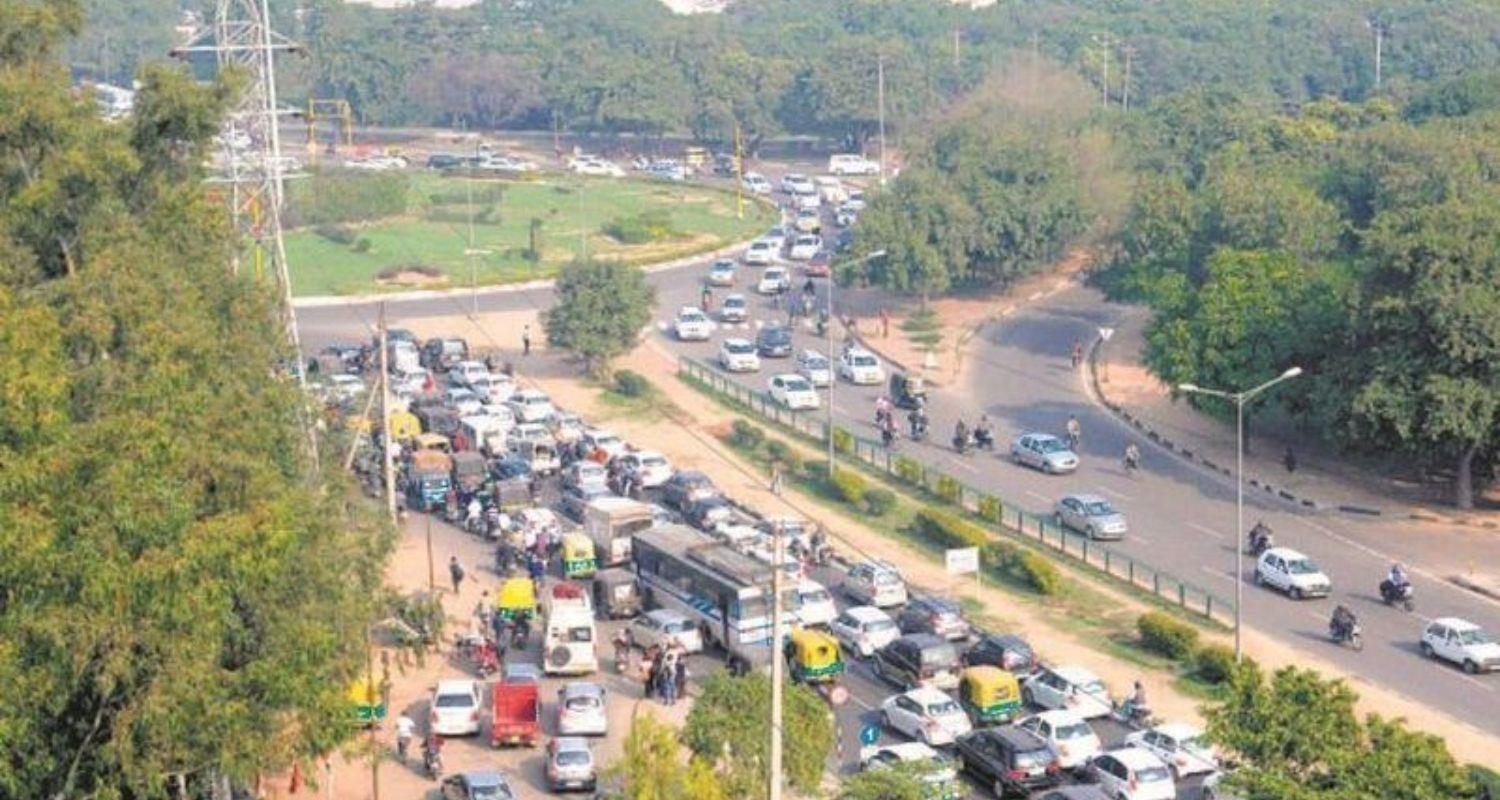
The Punjab and Haryana High Court on Friday ruled that the proposed flyover at Tribune Chowk on Dakshin Marg in Chandigarh could not be allowed as it violated the provisions of the Chandigarh Master Plan-2031. Delivering the order in open court, the Bench headed by Chief Justice Sheel Nagu observed that the construction of the flyover was impermissible under the city’s planning framework.
At the same time, the Bench clarified that while a flyover was not permissible under the Master Plan, an underpass could be considered as an alternative solution to address traffic congestion at the busy intersection.
The High Court also directed the authorities concerned to preserve and maintain Chandigarh’s original urban character and architectural identity, particularly in the Phase-I sectors and the Dakshin Marg stretch. Stressing the importance of planned urban development, the Bench emphasised that the city’s heritage and unique design philosophy must be protected from projects that could alter its visual and environmental balance.
The court further underlined the need to strengthen and expand public transport infrastructure in Chandigarh, observing that an efficient public transport system was necessary to reduce dependence on private vehicles and tackle increasing traffic congestion in the city.
The Bench had earlier stayed the felling and lopping of trees for the proposed project after taking note of submissions that several trees, including old mango trees standing for more than five decades, were likely to be cut to make way for the construction of the flyover.
At the time, the court had observed that since the matter was under active consideration and likely to be decided finally at an early stage, it was appropriate to restrain the authorities from cutting or trimming any mango trees or other trees located near Tribune Chowk.
The order came in response to a petition challenging the proposed flyover project on the grounds that it violated Chandigarh’s heritage character, environmental balance and planning framework.
During the hearing, counsel for the petitioners, advocate Tanu Bedi, argued that the proposed flyover was inconsistent with the provisions of Chandigarh Master Plan-2031 and would adversely impact the city’s urban design, green belts and pedestrian-friendly structure.
Referring to the Master Plan, the petitioner’s counsel contended that Chandigarh was originally envisioned as a city promoting pedestrian movement and cycling, and that elevated flyovers damaged both the visual landscape and the concept of non-motorised transport.
She further argued that expanding road infrastructure primarily for private vehicles would merely shift traffic congestion from one location to another rather than solving the problem. Describing the proposed project as “a death knell to Chandigarh heritage,” she maintained that the flyover would undermine the city’s carefully planned architectural and environmental identity.
On the other hand, UT senior standing counsel Amit Jhanji opposed the petition and argued that the Master Plan did permit the construction of flyovers in certain areas. He further submitted that only Sectors 1 to 30 were specifically recognised as heritage zones and not the entire city.
Jhanji also argued that the project had already undergone judicial scrutiny in the past. He pointed out that the High Court had previously vacated the stay on tree felling after a detailed review of the case on merits. He further stated that a challenge to that order before the Supreme Court no longer survived after the Special Leave Petition (SLP) was withdrawn in September 2024.
Defending the necessity of the project, Jhanji submitted that Chandigarh’s population and traffic volume had increased significantly over the decades. He argued that while the city was originally planned for a population of around five lakh, the present tri-city region population had crossed 15 lakh.
Also read: Nuh wall collapse during thunderstorm, 2 children killed
“Infrastructure development cannot remain frozen in 1950s concepts,” he argued, while describing the proposed flyover as a “functional necessity” to manage growing traffic pressure. He also highlighted that commuters travelling from Zirakpur and Delhi frequently faced traffic jams lasting up to one-and-a-half hours near Tribune Chowk, causing severe inconvenience and delays.
According to him, the project area fell within Phase II of Chandigarh, comprising sectors from Sector 31 onwards, which were designed to accommodate higher density development and more modern infrastructure as compared to the heritage-sensitive Phase I sectors.
Addressing environmental concerns, Jhanji informed the court that mitigation measures had already been planned, including the plantation of 2,799 saplings at a ratio of five trees for every one tree affected by the project.
He further argued that prolonged litigation since 2019 had delayed the project by nearly a decade, resulting in cost escalation and inconvenience to the public. He assured the court that all necessary environmental and statutory clearances would be obtained before the project was executed.

 Follow us