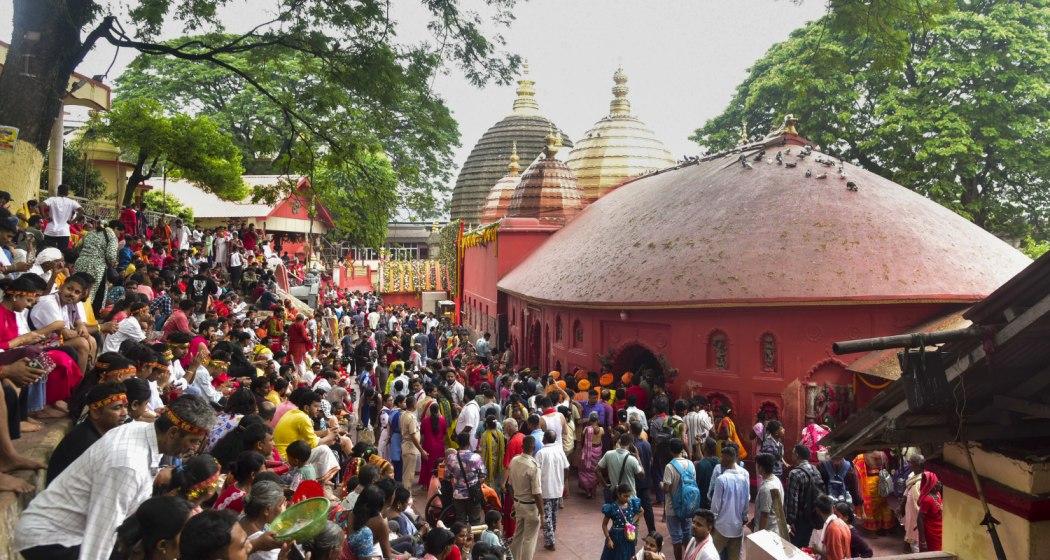
The annual Ambubachi Mela, revered as the 'Mahakumbh of the Northeast' and one of India's largest religious gatherings, commenced at the Kamakhya Temple atop Nilachal Hills on Monday night, drawing thousands of devotees, saints, sadhus and pilgrims from across the country to the revered shrine.
The ceremonial Pravritti ritual was performed at 9.08 pm, formally marking the beginning of the four-day festival. In keeping with centuries-old traditions, the temple doors were subsequently closed for three days to symbolise the annual menstruation period of Goddess Kamakhya, a powerful representation of feminine energy, fertility and creation in Hindu belief.
The festival, which holds immense spiritual significance for devotees, transforms Guwahati into a major pilgrimage centre every year. Authorities estimate that more than eight lakh visitors will participate in the mela this year. Even before the official commencement of the festival, large crowds had gathered on Nilachal Hills and at various transit points across the city, with pilgrims continuing to arrive from different states.
The Kamakhya Temple, one of the most revered Shakti Peethas in the country, occupies a unique place in Hindu spirituality. During Ambubachi, devotees believe that the goddess undergoes her annual menstrual cycle, and the temple remains closed to the public until the completion of the prescribed rituals.
Also read: Ambubachi Mela from June 22, Kamakhya readies for rush
The shrine is scheduled to reopen on June 26 following the conclusion of the Nivritti rituals and other customary ceremonies. Devotees will then be allowed to enter the temple and receive the sacred Angodak (holy water) and Angabastra (sacred cloth), both regarded as highly auspicious among followers.
To manage the expected influx of pilgrims, the Assam government, Kamrup (Metro) district administration and the temple management committee have put in place extensive arrangements. Security has been tightened across the temple complex and adjoining areas, while healthcare facilities, sanitation services, accommodation centres and food distribution systems have been strengthened for visitors.
Traffic restrictions have also been imposed around Nilachal Hills, with private vehicles barred beyond designated points. Special parking zones, shuttle services and dedicated public transport routes have been introduced to facilitate the movement of pilgrims.
Officials have advised residents and travellers to expect heavy traffic congestion in parts of Guwahati until June 26, particularly on routes leading to the temple and the airport.
For millions of devotees, Ambubachi is not merely a religious festival but a celebration of the divine feminine, making Kamakhya the spiritual epicentre of the Northeast during these four days.

 Follow us