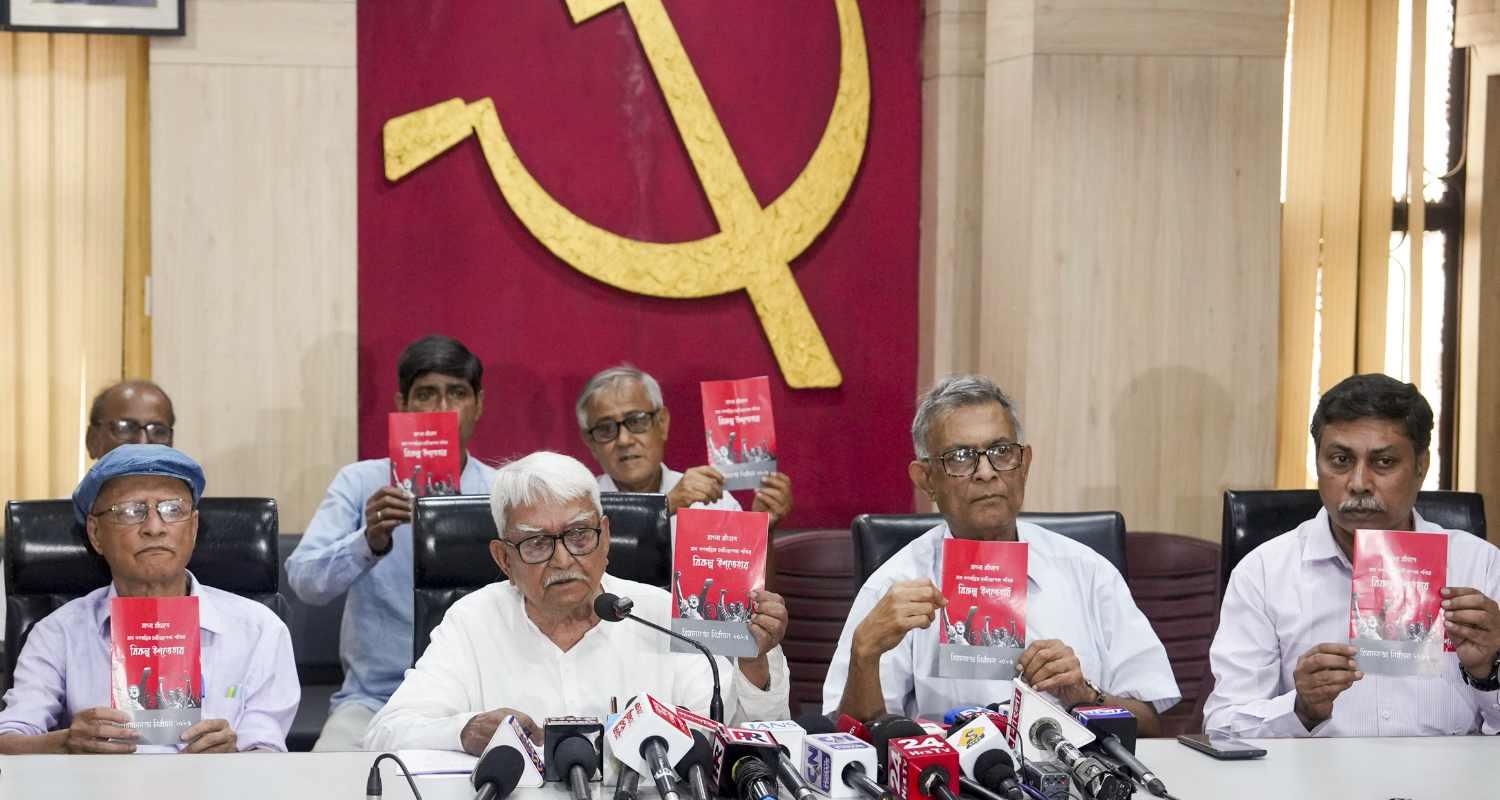
With a strong focus on employment and industrial growth, the Left Front (LF) on Saturday unveiled its manifesto for the West Bengal Assembly Elections, placing jobs, governance, and women’s safety at the centre of its campaign.
The manifesto was released at Pramod Dasgupta Bhawan in the presence of senior CPI(M) leaders Biman Bose and Mohammed Salim. Emphasising a shift from identity politics, the Lf declared, “Not temples or mosques—we want jobs,” positioning development as its core agenda.
The manifesto promises permanent employment opportunities for every family, with a commitment to provide at least two job options to every registered unemployed individual.
It also proposes 200 days of work annually in rural areas and 120 days in urban areas, alongside a pledge to fill all government vacancies within five years. The LF has assured that recruitment examinations—such as SSC, CSC, and PSC—will be conducted regularly and transparently.
In addition to promoting heavy and medium industries, the plan includes the revival of small-scale and cottage industries, as well as the establishment of IT parks.
The LF has proposed a daily wage of Rs 600 across rural and urban areas, while advocating a minimum wage of Rs 700 for workers in the unorganised sector.
Among key welfare measures, the manifesto promises an old-age pension of Rs 6,000, along with equal pay for equal work and social security provisions for marginalised and queer workers.
For non-income-tax-paying households, the LF has pledged free electricity up to 100 units and subsidised rates up to 200 units.
In the agricultural sector, the manifesto guarantees a Minimum Support Price (MSP) at 1.5 times the cost of production for 16 crops.
The Front has also outlined plans to allocate 20 per cent of the state budget to education and 10 per cent to healthcare. It promises free education up to the undergraduate level, along with the establishment of new medical colleges and modern hospitals in every district.
Against the backdrop of recent incidents, including the rape and murder at R. G. Kar Medical College and Hospital, the manifesto places significant emphasis on women’s safety. The LF has proposed the creation of a dedicated, autonomous ‘Abhaya Bahini’ (Protection Force) in every district. It also plans to establish 20 lakh self-help groups and ensure justice for victims of violence and abuse.
In its concluding remarks, the LF called for the creation of a “New Bengal—free from extortionists, not a franchise for looters.”
The manifesto proposes the formation of a Special Investigation Commission to probe corruption cases and measures to expedite the judicial process. On the issue of fundamentalism, leaders reiterated a policy of “zero tolerance,” urging voters to prioritise development over divisive politics.
As campaigning intensifies, the LF’s manifesto sets the tone for a development-centric pitch in what is shaping up to be a closely contested electoral battle.

 Follow us