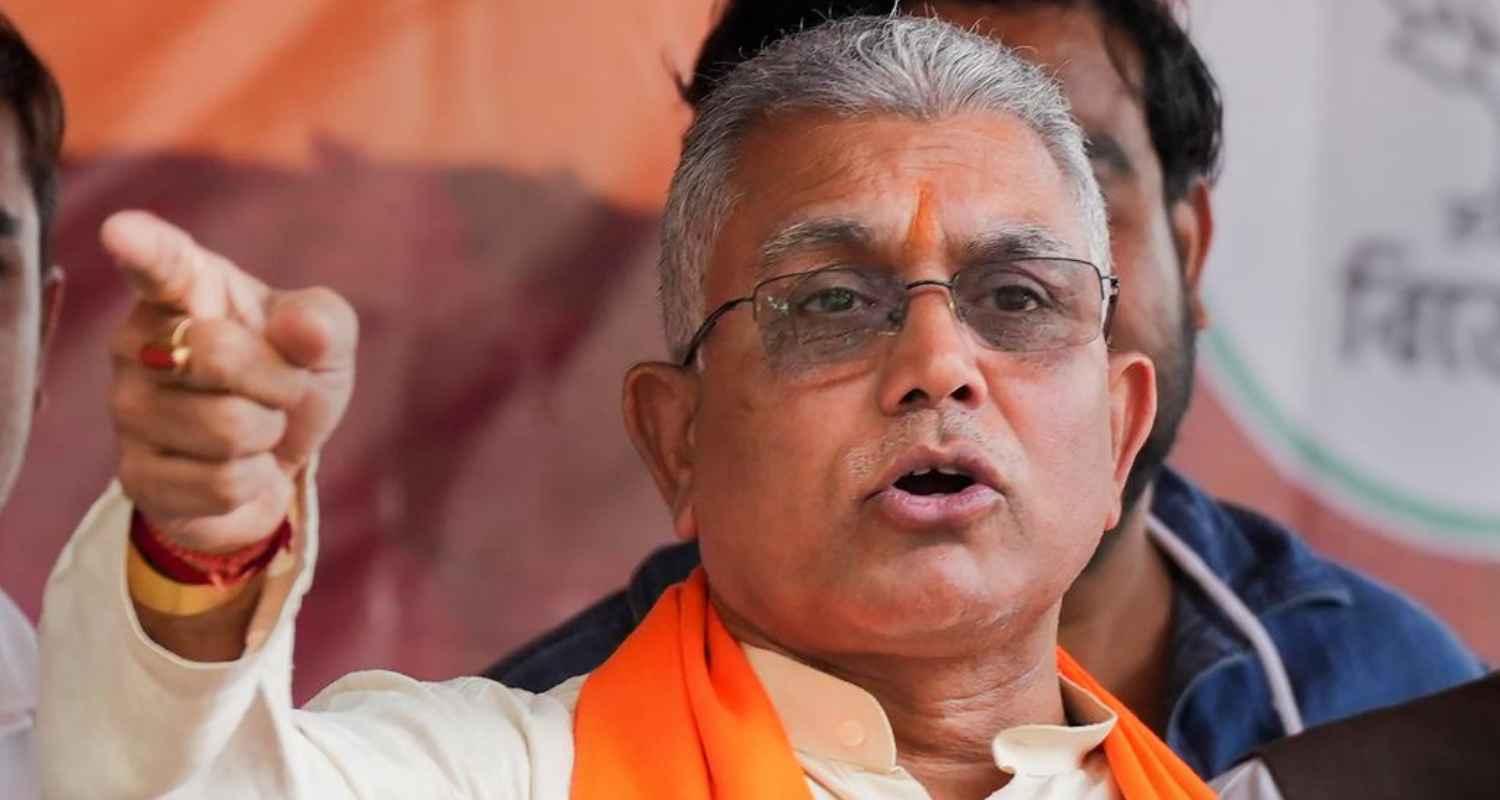
Few politicians in West Bengal’s political theatre command headlines quite like Dilip Ghosh—and fewer still manage to do so armed with nothing more than a discourse on cows. On Tuesday morning, the newly appointed state minister for Panchayats, Animal Resources, and Agricultural Marketing once again wandered into familiar ideological pastures, triggering equal parts amusement, disbelief, and political chatter with a fresh set of claims regarding the therapeutic virtues of indigenous cattle.
Addressing party workers at a casual roadside tea-circle gathering in Kankurgachi in North Kolkata, the senior BJP leader confidently declared that high blood pressure could be reduced simply by caressing a cow. More specifically, he prescribed gently stroking the hump or dewlap of an indigenous cow as a near-instant remedy for hypertension.
The remarks, delivered in Ghosh’s unmistakably unfiltered style, immediately reignited memories of his earlier “cow chronicles” that have periodically punctuated Bengal politics over the years.
Back in 2019, while serving as the BJP’s West Bengal president, Ghosh had famously claimed that cow’s milk contains “pure gold.” Elaborating further at a public rally in Burdwan, he argued that indigenous cows possess a special “gold vein” within the hump on their backs, enabling them to absorb sunlight and generate gold inside their bodies — a process he cited to explain the pale yellow tint of cow milk.
Then came the pandemic years, when he stirred another controversy by advocating the consumption of cow urine as an immunity booster during the COVID-19 crisis. Faced with ridicule from opposition parties and social media alike, Ghosh had retaliated with characteristic sharpness, remarking that “certain intellectuals” become uncomfortable whenever the virtues of cows are discussed, before adding that “donkeys can never understand the value of a cow.”
Tuesday’s remarks suggest that the minister’s faith in bovine healing powers remains entirely undiminished.
During the Kankurgachi interaction, Ghosh announced plans to soon convene a high-level meeting involving dairy industry stakeholders, businessmen, and operators of ‘gaushalas’ across the state. Yet before stepping into policy discussions, he once again chose to champion the medicinal and spiritual dimensions of what he referred to as “Gomata.”
In another anecdotal assertion that quickly drew attention, the minister narrated how a relative allegedly recovered from severe swelling after fresh cow dung was applied to the affected body part instead of seeking medical treatment. According to Ghosh, the ailment subsided within days.
The remarks have inevitably reopened an old debate surrounding politically influential endorsements of scientifically unverified remedies. Observers were quick to draw parallels with statements made years ago by former BJP MP Pragya Singh Thakur, who had similarly claimed that massaging a cow’s back could cure chronic hypertension.
As clips from Tuesday’s tea-circle interaction began circulating online, reactions ranged from laughter and memes to fierce political criticism. Yet, for admirers and critics alike, one thing remains undeniable: whenever Dilip Ghosh speaks about cows, Bengal listens—even if often with raised eyebrows.

 Follow us