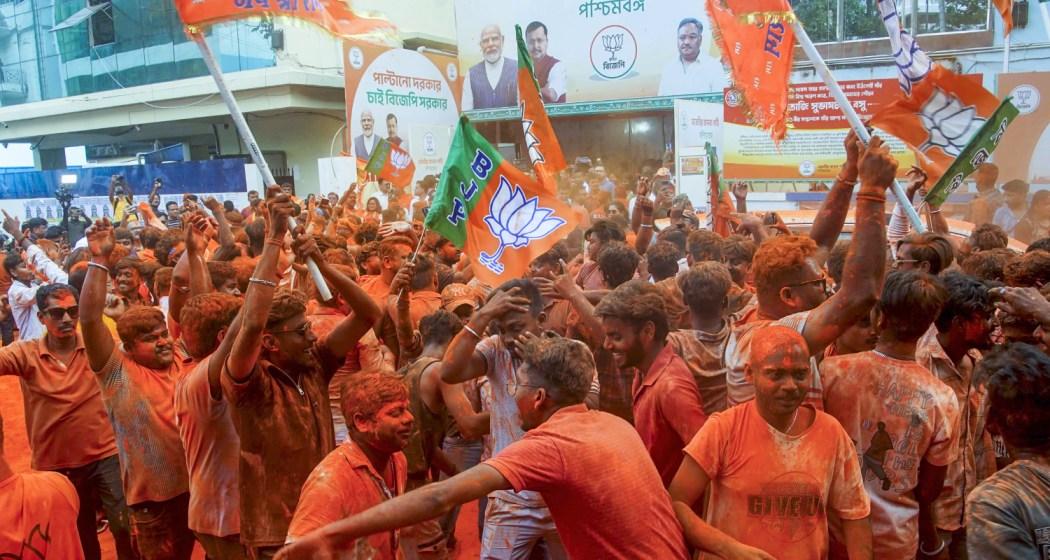
The Bharatiya Janata Party (BJP) on Monday appeared set to form its first government in West Bengal while retaining Assam for a third consecutive term, in what marks a decisive expansion of its political footprint across eastern and northeastern India.
According to Election Commission of India (ECI) data at 9:30 pm, the BJP had either won or was leading in around 195 of the 294 Assembly seats in West Bengal, comfortably crossing the halfway mark of 147. The ruling Trinamool Congress (TMC), led by Mamata Banerjee, was trailing with about 90 seats, indicating a sharp electoral reversal after three consecutive terms in power.
Prime Minister Narendra Modi termed the result “historic”, saying, “The 2026 West Bengal Assembly Elections will be remembered forever. People's power has prevailed and BJP's politics of good governance has triumphed.” He added that the party would “ensure opportunity and dignity to all sections of society”.
Union Home Minister Amit Shah, who led the BJP’s aggressive campaign in the state, credited cadre mobilisation and outreach in border, tribal and industrial regions for the breakthrough.
However, Banerjee rejected the trends, alleging irregularities in the counting process. “A false narrative is being spread,” she said, accusing the Election Commission of not declaring results in constituencies where the TMC was ahead. She also claimed that counting had been halted in some areas and urged party workers not to leave counting centres.
The election saw massive deployment of security forces, with over 2.5 lakh Central Armed Police Forces personnel stationed across the state. The campaign was marked by sharp polarisation, allegations of electoral manipulation, and intense contestation between the BJP and TMC.
The scale of the BJP’s lead suggests a structural shift in Bengal politics, with the party making deep inroads into regions where it had historically struggled, potentially ending the dominance of regional parties in the state.
Mamata alleges assault at counting centre
Outgoing CM Banerjee alleged she was assaulted by BJP workers inside a counting centre after her party’s electoral setback. Speaking after leaving the Sakhavat Memorial School centre, she claimed, “I was kicked, thrashed and beaten up… in front of central forces.”
Banerjee also accused the BJP of large-scale malpractice, alleging votes were “looted in nearly 100 constituencies” and that the Election Commission was acting at the BJP’s behest. She asserted such methods would not ensure lasting power and expressed confidence that the TMC would return.
Also read: No 'badla', time for 'badlav': PM Modi after Bengal win
Assam: NDA returns for third straight term
In Assam, the BJP-led National Democratic Alliance (NDA) secured a comfortable majority, reaffirming its dominance in the state. According to ECI data at 9:30 pm, the alliance had won 77 seats in the 126-member Assembly, well above the majority mark of 64.
The BJP accounted for 65 seats, while its allies, Asom Gana Parishad (AGP) and Bodoland People’s Front (BPF), won five and seven seats respectively. The NDA was also leading in several additional constituencies.
Chief Minister Himanta Biswa Sarma retained his Jalukbari seat by a massive margin of 89,434 votes, underlining his continued political dominance. “The people have once again reposed faith in us,” he had said during the campaign, emphasising governance and welfare delivery.
The Congress suffered a major setback, winning just seven seats and leading in 12. State party president Gaurav Gogoi lost in Jorhat to BJP veteran Hitendranath Goswami by over 23,000 votes, dealing a symbolic blow to the opposition.
Regional players such as the AIUDF, Raijor Dal and Trinamool Congress managed only marginal presence, securing one seat each.
Polling for all 126 constituencies was held on April 9, with a voter turnout of 85.96 per cent. Counting began at 8 am across 40 centres in 35 districts.
The back-to-back victories in Assam and a breakthrough in Bengal significantly strengthen the BJP’s position ahead of upcoming electoral battles, reinforcing its narrative of continued expansion despite challenges in the 2024 general elections.

 Follow us