
Trending:
James Webb: Rewriting the history of cosmology
Peering into the distant past, the telescope has been revealing incredible new details of the early universe, galaxies, potentially habitable exoplanets and even familiar objects in our solar system. Follow us
News Arena Network - Chandigarh - UPDATED: July 16, 2026, 01:58 PM - 2 min read
JWST is located 1.5 million kilometres from Earth, well beyond the orbit of the moon.
On July 12, 2022, an awe-struck world was treated to the first set of full-colour images beamed from the James Webb Space Telescope (JWST), the most sophisticated ‘window to the universe’ ever built by mankind.
It marked the beginning of a new era in astronomy.
A spate of discoveries made by the world's most powerful space observatory in the last four years has revolutionised our understanding of the early universe, galaxy formation, stellar evolution, black holes, and the atmospheres of distant exoplanets. Its discoveries have challenged long-held theories and opened new frontiers in the search for extraterrestrial life.
Jointly developed by NASA, the European Space Agency (ESA), and the Canadian Space Agency (CSA) over three decades, the USD 10 billion JWST is humanity's most ambitious eye in the sky.
Peering into the distant past, the telescope has been revealing incredible new details of the early universe, galaxies, potentially habitable exoplanets and even familiar objects in our solar system.
JWST is located 1.5 million kilometres from Earth, well beyond the orbit of the moon. Here its giant gold-plated mirror can look unhindered into the cosmos, protected by a tennis court–sized sunshield that blocks our star’s light and heat. All this gives JWST unprecedented sensitivity to some of the faint wisps of light reaching us from the first few hundred million years in which the first stars were kindled and galaxies coalesced.
Rewriting the story of cosmic dawn
If one has to choose the most significant among the discoveries made by the telescope so far, it is this: It found that the early universe grew up faster than anyone expected.
To the utter surprise of the astronomical community, the JWST images revealed that the early galaxies–formed just 300 to 400 million years after the Big Bang–were not faint and diffuse smudges, as was expected of the early galaxies. But they were bright, fully-formed and well-structured systems with stellar masses exceeding what standard galaxy formation models predicted possible at such early epochs.
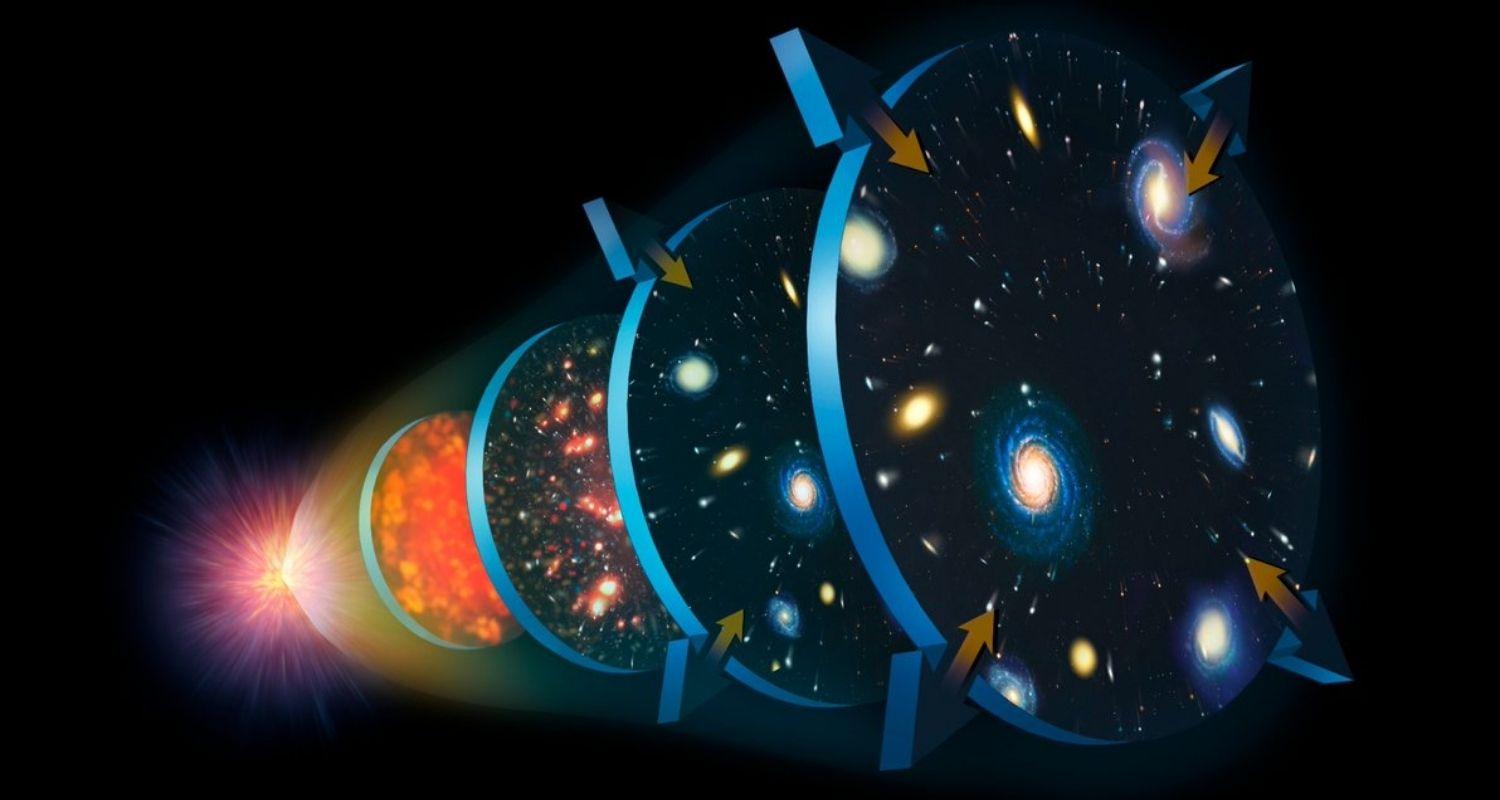
This virtually challenges the standard cosmic model which says that after the fiery Big Bang 13.8 billion years ago, the universe cooled, and energy turned into matter that eventually coalesced during the first few hundred million years, forming the first generation of infant stars and galaxies.
Astronomers thought they had a decent understanding of this process. Most models estimate that a galaxy the size of our Milky Way would not form until roughly 1 billion to 2 billion years after the Big Bang.
But surprisingly, what they found in the images of the early universe were full-fledged stars and galaxies.
The JWST’s results suggest that stars and galaxies were forming far faster than anyone expected. The observations showed staggering numbers of galaxies potentially existing as early as 180 million years after the Big Bang. These galaxies are also potentially more massive than cosmologists expected.
Adults playing in a kindergarten!
For the longest time, astrophysicists and cosmologists assumed that new-born galaxies would look like the orbs and spidery discs.
But, in an analysis of the new images from James Webb, baby galaxies were neither eggs nor discs. They were full-fledged, well-formed galaxies. It was like watching adults play in a kindergarten!
That is the tentative conclusion of a team of astronomers who re-examined images of some 4,000 new-born galaxies observed by Webb at the dawn of time.
This is a challenge to the standard model and could force the scientists to revisit the long-held assumptions. Besides profoundly altering the present understanding of how galaxies emerge and grow, the latest findings could also offer insight into the mysterious nature of dark matter, an invisible form of matter that astronomers say makes up a major part of the universe. Dark matter engulfs galaxies and provides the gravitational nurseries in which new galaxies arise.
Also read: What James Webb found in 3 years
Astronomers using the JWST have discovered a massive galaxy that is so old that its existence should be impossible, challenging current models on how these structures form. It is found to contain more stars than the Milky Way — despite forming just 800 million years after the Big Bang.
Analysing the JWST images pushes the boundaries of our current understanding of how galaxies form and evolve. Having these extremely massive galaxies so early in the universe is posing significant challenges to our standard model of cosmology. That could mean bringing new ideas to the forefront—while leaving others in the cosmic dustbin.
The mystery has only deepened with the telescope identifying supermassive black holes existing just 500 to 700 million years after the Big Bang that are far too massive to have grown from stellar-mass seeds through normal accretion. This hints at the possibility that either black holes can form directly from collapsing gas clouds, or that a piece of the standard cosmic growth model is missing entirely.
Search for habitable planets
Thanks to JWST's infrared capability that allows it to see through dense dust clouds where stars are born, scientists are now able to observe how planets emerge from disks of gas and dust with unprecedented detail.
The most exciting frontier is the search for habitable worlds. Unlike earlier telescopes, JWST, with its 6.5-meter mirror, can analyse the chemical composition of exoplanet atmospheres through transmission spectroscopy.
The telescope has detected water vapour, carbon dioxide, methane, sulphur dioxide, clouds and atmospheric circulation. One of the most discussed cases has been observations of K2-18 b, an exo-planet nearly 124 light years from the Earth where researchers have reported molecules such as methane and carbon dioxide and investigated possible biosignature gases. These findings remain under scientific scrutiny and are not evidence of extraterrestrial life, but they demonstrate JWST's remarkable ability to probe exoplanet atmospheres.
The telescope has detected complex organic molecules, water ice, carbon-rich compounds, silicates and hydrocarbons across the Universe, which are fundamental ingredients for planetary formation and, potentially, for life.
Although JWST cannot directly observe dark matter, its observations of galaxy formation and gravitational lensing will provide valuable constraints on models of dark matter and cosmic evolution.
Uniqueness of James Webb
To look outward into space is to peer into the past. The farther away a star or galaxy lies, the older it is, making every telescope a kind of time machine.
One of the JWST’s science objectives is to look into the distant reaches of the Universe to see how the first galaxies were born. It can do this because light takes billions of years to cross our cosmos. When the JWST collects this light, it is seeing those objects as they looked billions of years ago.
Soon after the big bang, as the universe expanded, the galaxies sped away from Earth so fast that their light has been stretched and shifted to infrared wavelengths which are invisible to the human eye. Beyond a certain point, the most distant galaxies are receding so quickly, and their light is so stretched in wavelength, that they are invisible even to the Hubble telescope.
Not anymore. Infrared vision is the key strength of JWST. It is offering a spectacular slide show of our previously invisible nascent cosmos. Ancient galaxies carpeted the sky like jewels on black velvet. Fledgling stars shining out from deep within cumulus clouds of interstellar dust. Hints of water vapor in the atmosphere of a remote exoplanet; This is both a new vision of the universe and a view of the universe as it once appeared new.
Deep in the delicate traceries of the Orion Nebula, about 1300 light years from Earth, the Webb has detected an important carbon molecule never before seen in interstellar space. Methenium is a carbon compound long predicted to play a pivotal role in organic chemistry. Since life as we know it is carbon-based, Methanium in interstellar space has implications for our understanding of how life might emerge elsewhere in the galaxy. This detection not only validates the incredible sensitivity of Webb but also confirms the postulated central importance of Methanium in interstellar chemistry.
The standard cosmological model remains robust, but JWST has highlighted important gaps in our understanding. Key questions being revisited include: How did galaxies become so massive so early? How were supermassive black holes formed? Was star formation much faster than predicted? Do current models adequately explain the first billion years of the universe?
The next decade promises even more transformative science.
