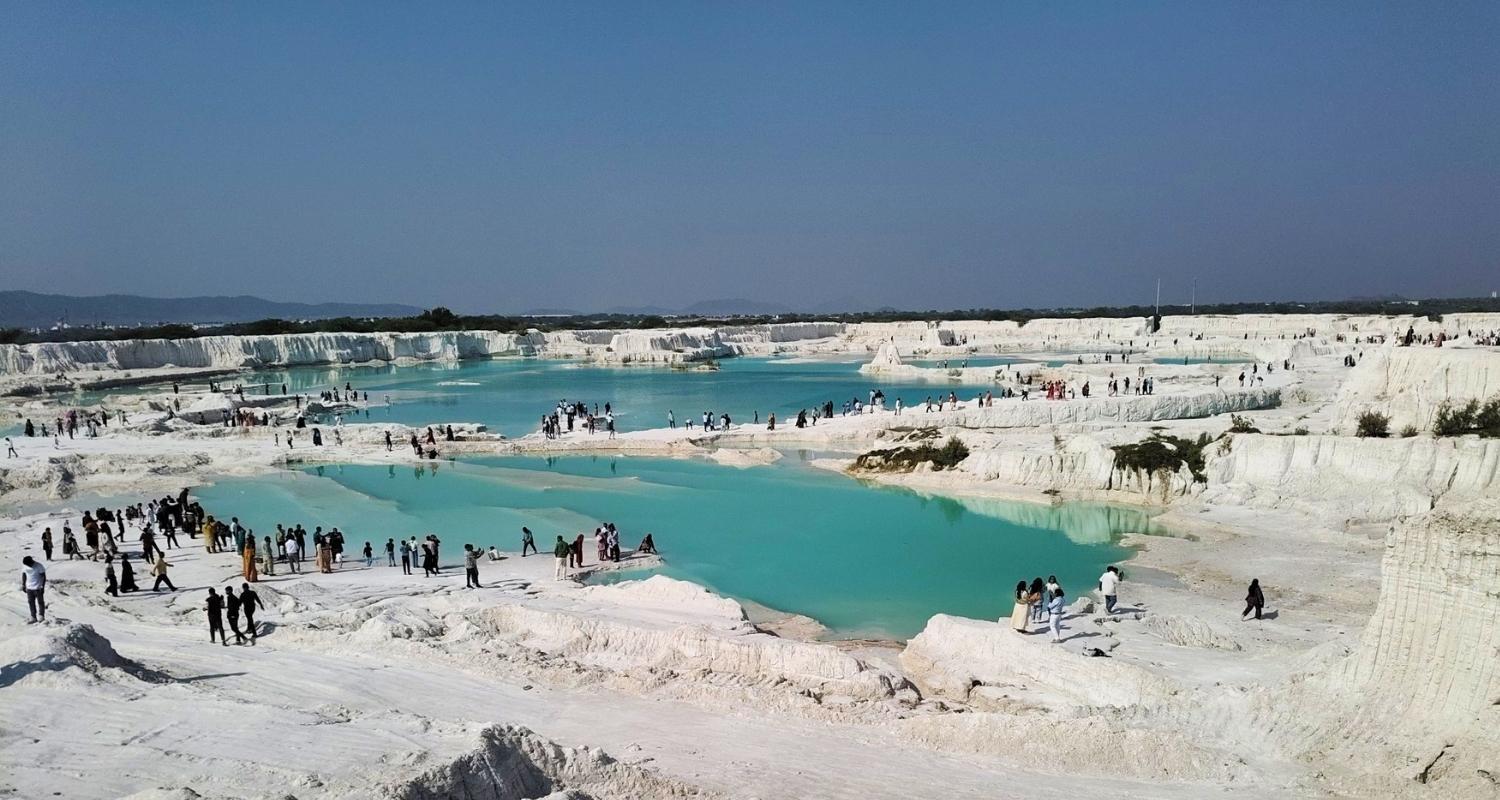
Indians’ obsession with Switzerland is not a surprise but a staple; a travel aspiration, a wishful cultural reference and thanks to late filmmaker Yash Chopra, also a celluloid stereotype. The fixation with the landlocked mountainous country runs deep enough to attract record Indian travellers each year; reportedly over 600,000 overnight stays in Swiss hotels in 2023. For those back home, several scenic corners of the nation have been labelled as “Mini Switzerland,” including a dumping yard for marble slurry.
A touristy pocket in the industrial city of Kishangarh in Rajasthan’s Ajmer district has been nicknamed Mini Switzerland for its vast stretch of dazzling snowy white landscape.
Then where’s the problem?
It is reportedly Asia’s largest marble waste dumping yard spread well over 200 acres where over 700 tankers unload every day. Over the years, the crystalline silica deposits have solidified to form white plateaus and hills and what appears to be a surreal white landscape. That’s not it. The sparkling chalky waste called crystalline silica, produced from marble cutting and polishing units nearby, has been flagged in several studies as a Group 1 human carcinogen.
Also read: Rusting rivers, record heat signal Arctic collapse
Central University of Rajasthan after thorough studies and research, has recently labelled Kishangarh as “a toxic tourist destination.” Health experts have warned that prolonged inhalation of these particles can lead to silicosis, a severe and irreversible lung disease.
Oblivious to the concerns and studies, or perhaps indifferent to it, the tourists continue to flock to the site and the authorities continue to dodge the issue. The location continues to be visited by children, women and medically vulnerable alike.
The site reportedly attracts 5,000 tourists daily and roughly 20,000 during weekends, with their visits formalised by Kishangarh Marble Association. The body that manages the area and charges fees, depending on the kind of access required; it’s Rs 500 for a camera, Rs 5,100 for pre-wedding shoots and Rs 21,000 for commercial productions.
In the maze of huge footfall, revenues and the sprawling ecosystem of tourism, public health concerns and environmental impact are yet to stand a chance. The site houses changing rooms, costumes and props on rent, horses, restaurants, kiosks and even a helipad.
Every few minutes the tankers arrive with marble slurry, as do the content creators and social media users, with their feeds gleefully filled with the surreal white stretch comparing it to the Alpine snowfields or shimmering salt flats of Bolivia.
An environmental catastrophe
Several people in the area and farmers nearby have complained of silica deposit on their crop and land. This apart from the concerns raised regarding poor air quality, high levels of lead silicate, nitrate and fluoride in soil and groundwater. The absence of safeguards against pollution and a protective green belt makes the area further unsafe. Ground water in nearby areas has shown total dissolved solid levels up to ten times the safe limit within a six kilometre radius.
Also read: Ancient coral reefs reveal urgent truths about today's climate
Fitness influencer Chirag Barjatya has warned about the place, on his social media handle, while mincing no words. “This place is in my hometown—Kishangarh (Ajmer), and I strongly advise you not to visit this place. This is marble dust. It is very poisonous and can literally puncture and harm your lungs permanently. The local population is already suffering. These Instagram and pre-wedding photographers colour-grade the pics to make them look beautiful, but in reality, it is not.”
In the absence of any official initiative, a few have resorted to satire. “Kishangarh emerges as a major tourist destination,” reads a piece of news from earlier this year on social media. “What about lungs?” questioned a netizen. “Oh don’t worry, the place is sponsored by big pharma,” jokes another one.
What are the authorities doing?
Who approved this carcinogen rich tourist site to be open? There’s no dearth of activists who have questioned the local authorities, state government and the Ministry of Health and Family Welfare. No amount of tags and hashtag activism has elicited beyond a generic response, let alone a concrete action, so far.
After the National Green Tribunal was notified about the concerning pollution levels and unrestricted access to the area, the judicial body constituted a joint committee with pollution control authorities to examine the situation. However, the site is yet to be closed to the tourists and there’s no dearth of them given the widespread connectivity of the area—it’s only 100 km away from Jaipur.
At the site, fine marble dust continues to drift through the air, as dreamy couples pose ahead of their wedding, children run around, some rubbing their eyes. While the tourists have been metaphorically rendered blind by the glittering marble dust, seemingly the authorities by the revenues.
By Manpriya Singh

 Follow us